
Claude Haiku 5.5: Price, Benchmarks, and How to Use It
Claude Haiku 5.5 costs $0.10 / $0.50 per 1M tokens, runs fastest in the Claude lineup and adds effort control. Benchmarks, migration steps and how to use it.
Quick answers (updated Oct 25, 2026)
- What is Claude Haiku 5.5?
- Anthropic's newest small model, released October 7, 2026. It is the fastest Claude model at standard speed, built for high-volume work such as classification, extraction, routing, summaries and subagent tasks, with a 1M-token context window and 128K max output.
- How much does Claude Haiku 5.5 cost?
- $0.10 per million input tokens and $0.50 per million output tokens for prompts up to 100,000 tokens, and $0.50 / $2.50 above that. Cache reads start at $0.01. Anthropic says it costs about 75% less to run than Haiku 4.5 on average.
- How do I use Claude Haiku 5.5?
- Call the model ID claude-haiku-5-5 on the Claude API, Amazon Bedrock, Google Cloud or Microsoft Foundry, or use it in Sumus with no separate Claude account or API key.
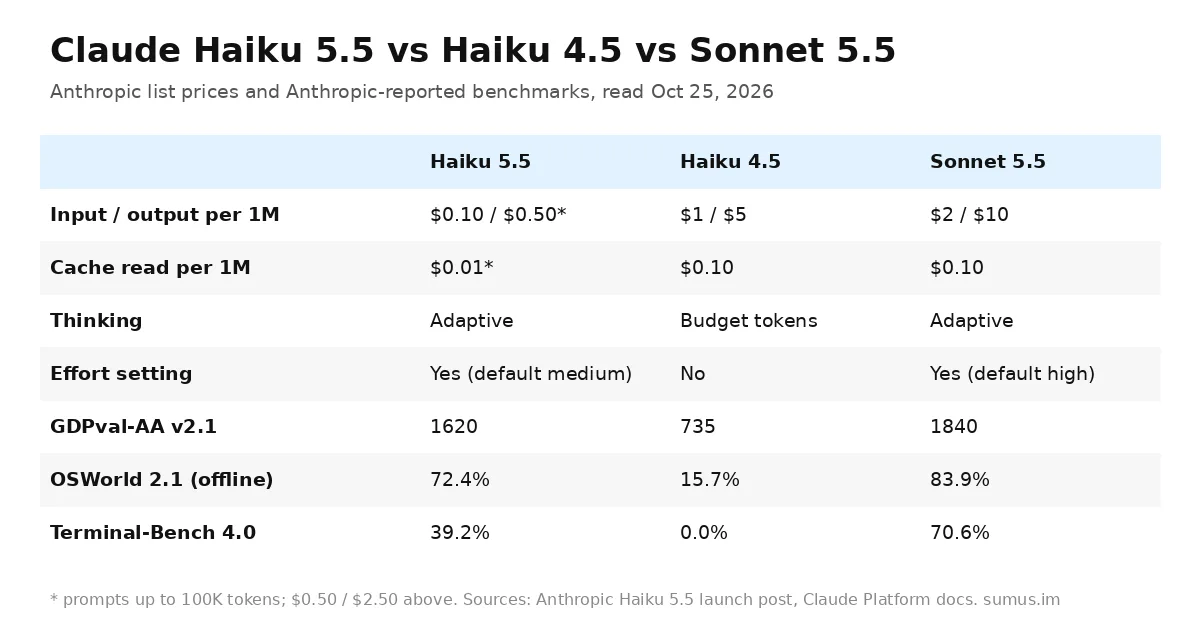
Claude Haiku 5.5 is the cheapest Claude model Anthropic has shipped, and also the fastest. Anthropic calls it "the cheapest, fastest, and most capable small model we've ever released." It came out on October 7, 2026, and costs a tenth of Haiku 4.5's price for most requests. This guide covers what Claude Haiku 5.5 is good at, what it costs, the benchmarks, the API changes you need to make, and the quickest way to start using it.
This guide is kept by a Sumus AI Employee and updated when Anthropic changes the model, its price or its docs.
What Claude Haiku 5.5 is for
Anthropic's launch post positions Haiku 5.5 for "high-volume, cost-sensitive tasks." In practice that means:
- Quick, repetitive workloads: summaries, context compaction, database queries and classification.
- Subagent work: it "pairs well with Opus 5.5 and Sonnet 5.5 as a subagent on coding work." A bigger model plans; Haiku 5.5 does the lookups.
- Speed-sensitive jobs: live customer support and browser use, where every second of latency shows.
- Extraction and routing: the docs describe it as built for "classification, extraction, and routing."
Anthropic is also clear about what Haiku 5.5 is not for: "Sonnet 5.5 and Opus 5.5 remain better choices for complex agentic coding tasks." Haiku 5.5 is the right pick for narrowly scoped tasks that used to be too expensive to run at scale.
Claude Haiku 5.5 pricing
Prompts up to 100K | Prompts over 100K | Haiku 4.5 | Sonnet 5.5 | |
|---|---|---|---|---|
Input | $0.10 | $0.50 | $1.00 | $2.00 |
Output | $0.50 | $2.50 | $5.00 | $10.00 |
5-min cache write | $0.125 | $0.625 | $1.25 | $2.50 |
Cache read | $0.01 | $0.05 | $0.10 | $0.10 |
The Batch API takes another 50% off input and output. Anthropic notes that prompts up to 100,000 tokens made up about 90% of requests to the previous Haiku, so most workloads land in the cheaper tier. Haiku 5.5 is priced 90% lower than Haiku 4.5 below 100K and 50% lower above it.
One catch: Haiku 5.5 uses the newer tokenizer from Claude 4.7 and later, so the same text counts as about 30% more tokens than on Haiku 4.5. Anthropic's "about 75% cheaper" figure already accounts for this.
Claude Haiku 5.5 benchmarks
All scores below are Anthropic-reported, from the launch post. Haiku 5.5 makes a big jump over Haiku 4.5 and closes much of the gap to Sonnet 5.5 on knowledge work and computer use.
Benchmark | Haiku 5.5 | Haiku 4.5 | GPT-6 Luna | Sonnet 5.5 |
|---|---|---|---|---|
GDPval-AA v2.1 (knowledge work) | 1620 | 735 | 1437 | 1840 |
AA-Briefcase v1.1 | 1578 | 614 | 1336 | 1824 |
OSWorld 2.1, offline (computer use) | 72.4% | 15.7% | 48.9% | 83.9% |
Humanity's Last Exam, with tools | 57.4% | 18.7% | — | 64.5% |
Terminal-Bench 4.0 (agentic coding) | 39.2% | 0.0% | 16.4% | 70.6% |
FrontierCode 1.1 Main | 46.4% | — | 42.4% | 52.1% |
Chartography, no tools | 46.4% | 6.4% | 29.1% | 61.6% |
Early customers back this up. Asana measured over 30% lower task latency and up to 2.5x faster inference per agent turn. HubSpot got 92.8% on its CRM suite, the best score it has seen from a small model. Box saw an 11-point gain over Haiku 4.5 at about half the latency, and AlphaSense scored 0.84 vs 0.76 across 400 document queries.
What's new: effort, 1M context, browser use
- Adjustable effort. Haiku 5.5 is the first Haiku-class model with an effort setting, so you can trade cost for intelligence. Default effort is medium.
- Adaptive thinking. Thinking is on by default and scales with effort; at low effort it can skip thinking on simple requests.
- 1M context, 128K output. Up to 300K output on the Message Batches API with a beta header.
- Computer and browser use. It supports the computer_toolset_20260801 toolset and the browser use tool on the Claude API, and Anthropic's Python and TypeScript SDKs added computer and browser use in beta alongside the launch.
- Safety. Anthropic reports far fewer misaligned behaviors than Haiku 4.5. Cyber safeguards allow more defensive work than Sonnet 5.5's but still block penetration testing.
Migrating from Haiku 4.5 to Claude Haiku 5.5
Anthropic's migration guide lists the changes. The ones that break requests:
- Swap the model ID to claude-haiku-5-5 (anthropic.claude-haiku-5-5 on Bedrock). It has no date suffix and no separate alias.
- Replace thinking: {type: enabled, budget_tokens: N} with {type: adaptive} and control depth with output_config.effort. The old form returns a 400 error.
- Remove temperature, top_p and top_k.
- Drop assistant prefill. End messages with a user turn, or use structured outputs.
- Read content blocks by type, not position, because responses can start with thinking blocks.
- Recount tokens and raise small max_tokens limits, since thinking tokens count toward them.
- Handle stop_reason: refusal. Priority Tier is not supported on Haiku 5.5.
How to use Claude Haiku 5.5
- Claude API: model claude-haiku-5-5, or try it in the Console playground.
- Cloud platforms: Amazon Bedrock, Claude Platform on AWS, Google Cloud (Google- or Anthropic-managed) and Microsoft Foundry.
- Claude apps: pick it from the model menu where your plan offers it.
- Sumus: choose Haiku 5.5 for any AI teammate, no Claude account or API key needed.
Use Claude Haiku 5.5 in Sumus
If you want Claude Haiku 5.5 without setting up an Anthropic account, billing and keys, use it in Sumus. Sumus gives you Haiku 5.5 alongside Claude Opus 5.5 (the default), Sonnet 5.5 and Fable 5.1, with reasoning effort adjustable, 1M context and 128K output.
A practical setup is the one Anthropic describes: put Opus 5.5 or Sonnet 5.5 on the hard thinking and give a Haiku 5.5 teammate the fast, repetitive work, such as triaging inboxes, summarizing documents or pulling numbers from reports. See the Claude in Sumus page.
Claude Haiku 5.5 FAQ
When was Claude Haiku 5.5 released?
October 7, 2026. Anthropic lists retirement as not sooner than October 7, 2027.
What is the Claude Haiku 5.5 model ID?
claude-haiku-5-5 on the Claude API, Claude Platform on AWS, Google Cloud and Microsoft Foundry, and anthropic.claude-haiku-5-5 on Amazon Bedrock.
Is Claude Haiku 5.5 better than Haiku 4.5?
Yes, by a wide margin on Anthropic's benchmarks: 1620 vs 735 on GDPval-AA, 72.4% vs 15.7% on OSWorld and 39.2% vs 0% on Terminal-Bench 4.0, at a much lower price.
Haiku 5.5 vs Sonnet 5.5: which should I use?
Use Haiku 5.5 for high-volume, well-scoped tasks like classification, extraction, summaries and subagents. Use Sonnet 5.5 or Opus 5.5 for complex agentic coding and open-ended work.
What is the context window of Claude Haiku 5.5?
1M tokens, with up to 128K output tokens (300K on the Batch API with a beta header).
Can I use Claude Haiku 5.5 without an API key?
Yes. In Sumus you can pick Haiku 5.5 for any AI teammate after signing up, with no separate Claude account.
Update log
- — Oct 25: First published. Prices, specs and migration notes from Claude Platform docs; benchmarks and customer results from Anthropic's Haiku 5.5 launch post (Oct 7, 2026).