
Claude Fable vs Opus 5.5 (and Sonnet 5.5): Which to Use
Fable vs Opus: Claude Fable 5.1 vs Opus 5.5 vs Sonnet 5.5 on price, speed and Anthropic benchmarks, plus which model to use. Fable 5.5 isn't out yet.
Quick answers (updated Oct 24, 2026)
- Fable vs Opus: which is better?
- For most work, Claude Opus 5.5. Anthropic says it performs at the level of Fable 5.1 on most work at 40% of the per-token price, and it leads Fable 5.1 on Anthropic's coding and knowledge-work benchmarks. Use Fable 5.1 for hours-long agent sessions and the hardest reasoning when Opus 5.5 at high effort still falls short.
- Sonnet 5.5 vs Opus 5.5?
- Sonnet 5.5 is half the price ($2 / $10 per million tokens) and faster, and nearly ties Opus 5.5 on GDPval-AA (1844 vs 1846). Opus 5.5 stays stronger on complex, open-ended work needing sustained judgment.
- Is this Fable 5.5?
- No. The current Fable model is Claude Fable 5.1, released September 1, 2026. Claude Fable 5.5 has not been officially released as of October 24, 2026.
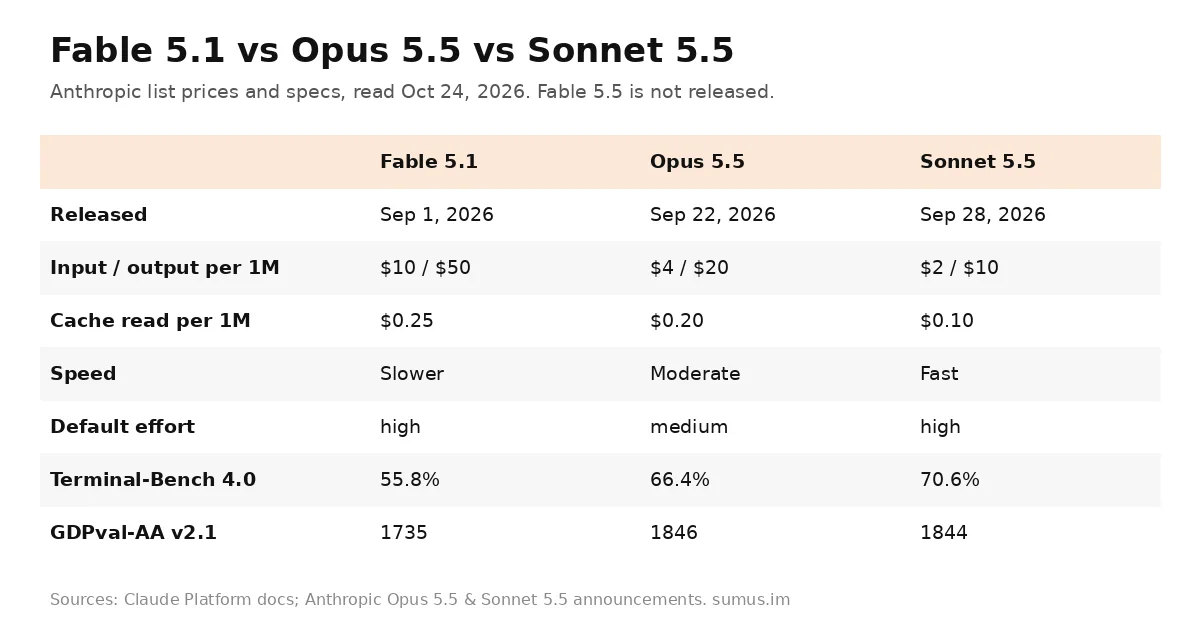
Fable vs Opus is the most common question about Claude's lineup right now, because Anthropic shipped Opus 5.5 three weeks after Fable 5.1 and said it matches Fable on most work for much less. Then Sonnet 5.5 landed six days later and nearly tied Opus 5.5 on knowledge work. Here is how the three compare, using Anthropic's own numbers, and when each one is the right pick.
Anthropic's model guide puts it plainly: "Most workloads start with Claude Opus 5.5." This comparison is kept by a Sumus AI Employee and updated when the lineup changes.
Fable vs Opus at a glance
Fable 5.1 | Opus 5.5 | Sonnet 5.5 | |
|---|---|---|---|
Positioning | Demanding reasoning, long-horizon agents | Long-running agentic coding and knowledge work | Best mix of speed and intelligence |
Price per 1M (in / out) | $10 / $50 | $4 / $20 | $2 / $10 |
Cache reads | $0.25 | $0.20 | $0.10 |
Latency | Slower | Moderate | Fast |
Thinking / default effort | Adaptive, always on / high | Adaptive, always on / medium | Adaptive / high |
Context / max output | 1M / 128K | 1M / 128K | 1M / 128K |
Terminal-Bench 4.0 | 55.8% | 66.4% | 70.6% |
CursorBench 4.0 | 51.8% | 57.8% | 55.5% |
GDPval-AA v2.1 | 1735 | 1846 | 1844 |
Humanity's Last Exam (tools) | 65.6% | 67.7% | 64.5% |
Benchmarks are Anthropic-reported, from the Opus 5.5 and Sonnet 5.5 launch posts. All three share a June 2026 knowledge cutoff.
Opus 5.5 vs Fable 5.1
Opus 5.5 (September 22) was the first model of the Claude 5.5 family. Anthropic's launch post says it "performs at the level of Claude Fable 5.1 on most work and costs 40% less to run than Opus 5." Per token it is 60% cheaper than Fable 5.1 on input and output.
- Coding. Opus 5.5 leads on Terminal-Bench 4.0 (66.4% vs 55.8%), FrontierCode (54.4% vs 50.3%) and CursorBench (57.8% vs 51.8%). Translating HAProxy from C to Rust, both passed nearly all regression tests; Opus 5.5 took 9.5 hours vs 12 and cost 51% less.
- Research accuracy. In a sourced earnings-report test, 16 of 18 Opus 5.5 reports passed a zero-invented-figures bar; Fable 5.1 cleared it in no attempt.
- Safety. Opus 5.5 ties Fable 5.1 for the lowest prompt-injection success rate in Gray Swan's benchmark.
- Where Fable 5.1 still wins. Anthropic calls Fable 5.1 its most capable model open to all customers and recommends it for agent sessions that run for hours, multistep deep research, and analysis carried through to a finished document, spreadsheet or deck. Its guide says to move to Fable 5.1 when Opus 5.5 evals at xhigh or max effort still fall short.
Anthropic itself notes that "the gap between Opus 5.5 and Claude Fable 5.1 is narrower than these scores suggest." The practical rule for opus 5.5 vs fable 5.1: default to Opus, escalate to Fable for the few jobs where Opus at max effort isn't enough.
Sonnet 5.5 vs Opus 5.5
Sonnet 5.5 (September 28) is pitched as "a faster, lower-cost complement to Claude Opus 5.5." Per Anthropic's Sonnet 5.5 post, it runs 30%+ faster than Sonnet 5 and costs half of Opus 5.5 per token.
- Close on knowledge work. GDPval-AA 1844 vs 1846; OSWorld 80.1% vs 81.8%; AA-Briefcase 1811 vs 1822.
- Ahead on terminal coding. Terminal-Bench 4.0 70.6% vs Opus 5.5's 66.4%; within about two points on CursorBench.
- Behind on harder coding and reasoning. FrontierCode 46.2% (max) vs 54.4%; Humanity's Last Exam 64.5% vs 67.7%; Chartography no-tools 61.6% vs 64.4%.
- Best use. Well-scoped everyday tasks, bug fixes, polished documents, slides and spreadsheets, and design. Anthropic says Opus 5.5 "remains clearly stronger at complex, open-ended work requiring sustained judgment."
A pattern early testers describe: let Opus 5.5 set the architecture, then hand implementation to Sonnet 5.5. Anthropic's docs also support pairing them, with a cheaper executor consulting Opus through the advisor tool.
Fable vs Opus vs Sonnet: which to use
If you need | Use |
|---|---|
A default for coding, agents and knowledge work | Opus 5.5 |
Hours-long agent runs, deep research, finished decks or models where Opus at max still falls short | Fable 5.1 |
Speed and lower cost on well-scoped tasks, docs and slides | Sonnet 5.5 |
Lowest latency at high volume | Haiku 5.5 |
Before switching models, try the effort setting first: Anthropic says tuning effort "is often a better lever than switching models." Opus 5.5 defaults to medium; Fable 5.1 and Sonnet 5.5 default to high.
What about Fable 5.5?
Fable 5.5 is not out. Model IDs like claude-fable-5-5 have shown up in cloud catalogs and developer tools, but Anthropic has made no announcement as of October 24, 2026. Any "Fable 5.5 vs Opus" result today is speculation. We track the signals on our Fable 5.5 release date page, and will update this fable vs opus comparison the day it ships.
Try Fable, Opus and Sonnet side by side in Sumus
The fastest way to settle fable vs opus for your own work is to give the same task to both. In Sumus you can use Claude Opus 5.5 (the default), Sonnet 5.5, Fable 5.1 and Haiku 5.5 in one workspace, with reasoning effort adjustable up to max, 1M context and 128K output, and no separate Claude account or API key.
Run a task on Opus 5.5, rerun it on Fable 5.1 or Sonnet 5.5, and have a GPT-6 or Grok teammate review both. See the Claude in Sumus page.
Fable vs Opus FAQ
Is Claude Fable better than Opus?
Not on most tasks. Anthropic says Opus 5.5 performs at Fable 5.1's level on most work and it scores higher on Anthropic's coding and GDPval-AA benchmarks. Fable 5.1 is still recommended for the longest, hardest agentic and research work.
Why is Fable 5.1 more expensive than Opus 5.5?
Fable 5.1 is $10 / $50 per million tokens versus $4 / $20 for Opus 5.5. Opus 5.5 is a newer, more efficient model that needs less compute to serve, per Anthropic.
Is Sonnet 5.5 as good as Opus 5.5?
Close on knowledge work and terminal coding, at half the price. Opus 5.5 remains stronger on complex, open-ended tasks, FrontierCode and Humanity's Last Exam.
Has Claude Fable 5.5 been released?
No. As of October 24, 2026, the latest Fable model is Fable 5.1. Fable 5.5 is rumored but not announced.
Which Claude model is the default?
Anthropic recommends starting with Claude Opus 5.5 for most workloads. Opus 5.5 is also the default Claude model in Sumus.
Can I compare Fable 5.1 and Opus 5.5 without an API key?
Yes. Sumus gives you Fable 5.1, Opus 5.5, Sonnet 5.5 and Haiku 5.5 in one workspace after signing up, so you can run the same task on each.
Update log
- — Oct 24: First published. Specs and prices from Anthropic's Claude Platform docs; benchmarks from Anthropic's Opus 5.5 (Sep 22) and Sonnet 5.5 (Sep 28) announcements. Fable 5.5 still unreleased.