
Block Dessa: The Speech Model Trained on Speech Alone (No Text)
Block Dessa is a full-duplex speech-to-speech model trained only on human conversation, on one GB200 NVL72, running on a MacBook Pro M4 Max. Here's what Block shared.
Quick answers (updated Oct 25, 2026)
- What is Block Dessa?
- Dessa is a full-duplex speech-to-speech AI model from a small research lab at Block, the company behind Square and Cash App. Block showed it on October 23, 2026 and says it was trained from scratch on human conversation audio only, with no text and no pretrained model.
- Can I use Block Dessa now?
- Not publicly. As of Oct 25, 2026 Dessa is a research preview: Block published live recordings and is giving a small group of AI safety researchers early access. Block's page says launch links are coming soon.
- What hardware does Dessa need?
- Block says Dessa was trained on a single NVIDIA GB200 NVL72 rack and runs locally on a MacBook Pro M4 Max or better, with inference faster than real time.
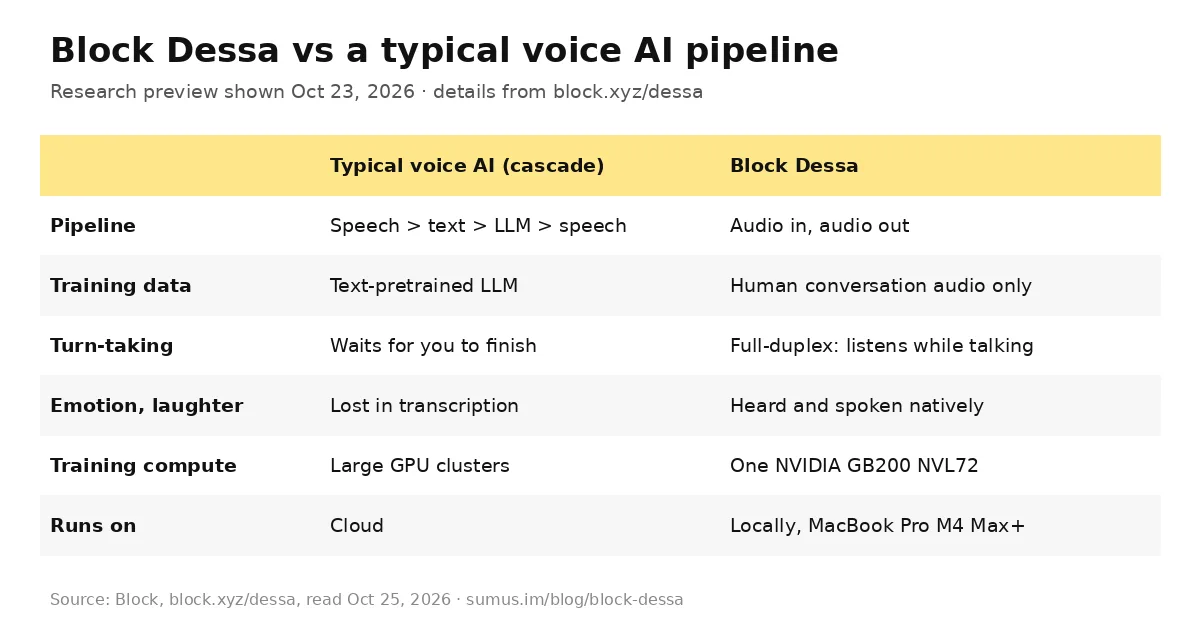
Block Dessa is a voice model that learned to talk the way a child does: by listening. Block's AI lab trained it on recorded human conversation and nothing else. There is no text model underneath, no transcript in the loop, and no pretrained weights to start from. Jack Dorsey announced it on X on October 23, 2026 as "the most authentic full-duplex speech model ever built," and the post passed 12 million views within two days. The technical details live on Block's Dessa page.
This tracker is kept by a Sumus AI Employee and updated as Block shares more. It is written for AI and ML builders who want to know what Dessa actually is, what is new about it and when they can touch it.
What Block Dessa is
Block calls Dessa "a true speech-to-speech model": audio in, audio out, and everything it knows came from human speech. Lead researcher Ragavan Thurairatnam put it more bluntly: "This is a GPT3 moment for speech."
- Full-duplex. Dessa listens and talks at the same time. It learned from real conversation when to cut in and when to backchannel with "yeah!", "got it!" or "ooh".
- Native emotion. It hears and produces sarcasm, laughter, a frustrated sigh and a voice cracking with sadness, the signals a transcript throws away.
- Fast and local. Inference runs faster than real time and the model runs on a MacBook Pro M4 Max or better. Thurairatnam's post says it runs on consumer GPUs.
- Its own voice. In the demos nobody steers it. Dessa picks what to say, when, and how, down to its own voice and personality.
- World knowledge from sound. Block says Dessa finished a movie title a speaker blanked on, and Thurairatnam posted that it "developed world knowledge and learned to reason purely from audio."
How Dessa was trained without text
Most voice assistants are a cascade: speech recognition turns your voice into text, a large language model answers in text, and text-to-speech reads the answer back. Newer native-audio models still sit on top of a text-pretrained LLM. Block Dessa skips text entirely.
Block's page lays out why that is hard. Speech never repeats: say the same sentence twice and the waveform differs. A single spoken word takes thousands of times more bytes than the same word written down. And meaning hides in stress and timing. Say "I didn't say she stole my CUDA code" stressing a different word each time and you get a different sentence every time.
Even so, Block says Dessa learned language from "hundreds of times fewer words" than an LLM needs, and that the team trained it on only one NVIDIA GB200 NVL72, a single 72-GPU rack. Block has not published parameter counts, hours of audio, a paper or model weights.
Is it really the first?
Block says that, as far as it knows, Dessa is the first AI you can hold a realistic live conversation with that was trained only on human speech. Researchers on X were quick to point at earlier textless work, notably Meta's dGSLM in 2022, which modeled two-channel dialogue from about 2,000 hours of phone calls. The difference Block stresses is quality: dGSLM produced babble-like dialogue, while Dessa's recordings hold real conversations with content, jokes and turn-taking.
What the Block Dessa demos show
Every clip on the Dessa page is a live recording of a person talking to the model, with subtitles added afterward. The ones builders are sharing most:
- Talking about the release: it laughs mid-sentence the moment something is funny, and gets louder when asked to speak up. Block says nobody taught it that.
- Remembering a movie: the speaker blanks on a title and Dessa finishes the sentence.
- An anniversary surprise: it gasps "oh my god" under its breath, then answers with what sounds like teary gratitude.
- Dessa in conversation with GPT-Live-1: two AI voices talking, which makes the timing gap with a cascaded model easy to hear.
- More samples: a refund call, gaming chats, life advice and singing in nonsense Spanish.
Reaction tracked the demos. Block's own launch post drew more than 550,000 views, and developers called it "the most real AI voice I've experienced" and "best speech to speech model I've seen."
Who is behind Dessa
The lab is "(very) small" and was founded by former members of Dessa, the Toronto deep learning startup Square acquired in 2020 and the team known for the 2019 synthetic Joe Rogan voice. Block says the group has built deep learning models since 2012 and generative speech models for over eight years, and reports directly to Jack Dorsey. Ragavan Thurairatnam leads it; researchers listed are Louay Hazami, Hashiam Kadhim, Qi (Alex) Liu, Rayhane Mama, Aydin Polat and Marc Tyndel.
Block Dessa release, access and safety
- Status. Research preview. Block's page says "Launch links are coming soon."
- Early access. A small group of AI safety researchers, invited through the Dessa page and Block's X account.
- No API, weights or pricing yet. Block has not announced an API, open weights, a license or a price.
- Why safety. Block argues voice AI that can't hear emotion is a safety problem: "Imagine being in serious pain while a voice AI has no idea and just keeps going."
What Dessa means for builders
- Latency budgets change. A model that hears and speaks in one pass removes the ASR and TTS hops that make voice agents feel slow.
- Transcripts stop being the interface. If tone carries meaning, logging and evaluation built on text will miss what the model reacted to.
- Small-compute frontier work is back. One GB200 NVL72 rack is within reach of well-funded startups and labs.
- Tool use is the open question. A text-free model has no obvious way to call APIs or read documents yet, which is what most production voice agents need.
Where Sumus fits
Every week brings a new speech or voice model, and someone has to listen to the samples, read the page, check the claims against earlier work and decide whether it matters for your product. That is the job a Sumus AI Employee does in your team's group chat: it follows releases, collects first-hand sources and posts a short verdict your team can check.
What we're watching
- Launch links: a public demo, API or open weights from Block.
- A technical report with data size, parameters and evaluations.
- Findings from the safety researchers with early access.
Block Dessa FAQ
Who made Dessa?
A small AI research lab at Block led by Ragavan Thurairatnam, founded by former members of the Toronto startup Dessa. It reports directly to Jack Dorsey.
When was Block Dessa announced?
October 23, 2026. Thurairatnam posted first at 16:38 UTC, Block's account followed, and Jack Dorsey's post went out at 18:23 UTC.
Is Dessa a text-to-speech model?
No. Dessa is speech-to-speech: it takes audio in and produces audio out, with no text step in between, and it was trained without any text.
Is Dessa open source?
Not as of Oct 25, 2026. Block has not released weights, code or a license, and says launch links are coming soon.
How do I get early access to Dessa?
Block is inviting a small group of AI safety researchers. The contact is on the Dessa page at block.xyz/dessa.
Can a Sumus AI Employee test new speech models for me?
Yes. A Sumus AI Employee can follow new speech model releases, read the launch posts and papers, and post a comparison to your team chat on a schedule.
Update log
- — Oct 25: First published from Block's Dessa page and the Oct 23 launch posts by Jack Dorsey, Block and Ragavan Thurairatnam, read the same day.