
DeepSeek 1017: V4.1 Flash 1017 Benchmarks, Pricing & Changes
DeepSeek 1017 (V4.1-Flash-1017, Oct 17, 2026): Terminal-Bench 31.2→42.3, shorter outputs, same $0.15/$0.60 price, 1M context. Full benchmarks and how to use it.
Quick answers
- What is DeepSeek 1017?
- DeepSeek 1017 is DeepSeek-V4.1-Flash-1017, the October 17, 2026 update of DeepSeek V4.1 Flash. It replaced the old Flash on DeepSeek's website, app and API under the same deepseek-flash model name, at the same price.
- What changed in the DeepSeek 1017 build?
- Better scores on every agent and coding benchmark DeepSeek lists (Terminal-Bench 4.0 rose from 31.2 to 42.3), shorter outputs and faster task completion. The weights are open under MIT.
- How much does DeepSeek 1017 cost?
- $0.30 input / $1.20 output per 1M tokens at peak, half that off-peak ($0.15 / $0.60), and $0.003-$0.006 for cached input. Context is 1M tokens with up to 384K output.
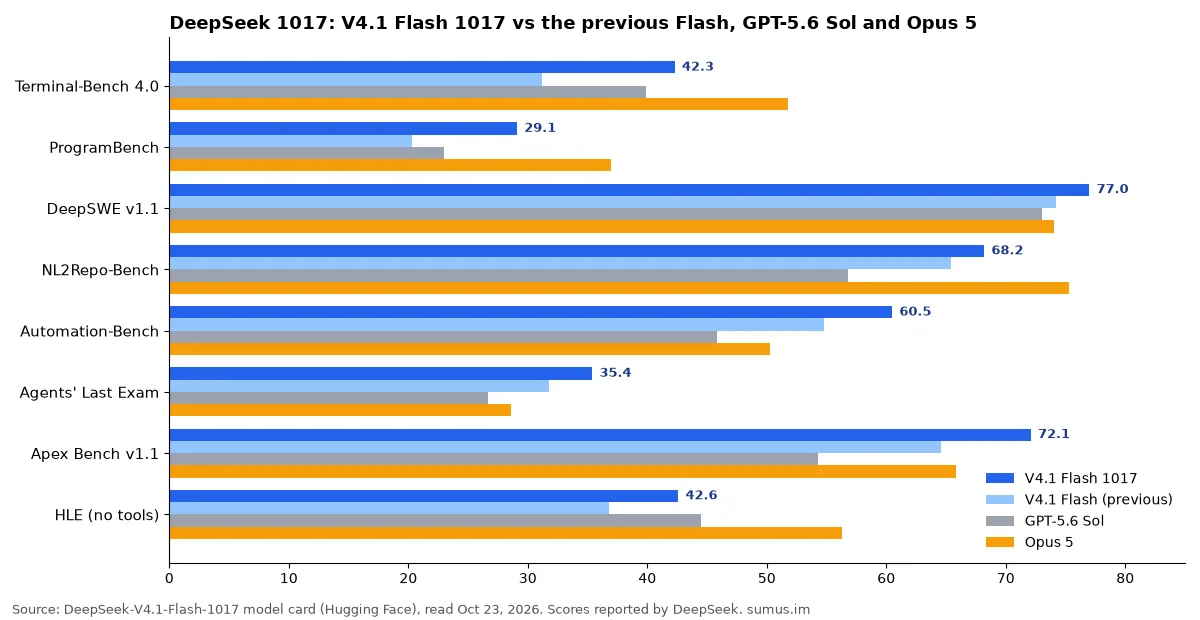
DeepSeek 1017 is a post-training refresh, not a new model generation. DeepSeek shipped DeepSeek-V4.1-Flash-1017 on October 17, 2026, swapped it into chat.deepseek.com, the mobile app and the API, and published the weights on Hugging Face and ModelScope the same day. If you call deepseek-flash today, you are already using DeepSeek 1017.
The fastest way to try DeepSeek 1017 without an API key, a top-up or a GPU cluster is to use DeepSeek V4.1 Flash inside Sumus, where a Sumus AI Employee runs it for you in a team chat. The rest of this post covers what changed, the full benchmark table, pricing, specs and every way to run it.
- DeepSeek 1017 = DeepSeek-V4.1-Flash-1017, released October 17, 2026, MIT license.
- Terminal-Bench 4.0: 42.3, up from 31.2, ahead of GPT-5.6 Sol (39.9) and GLM-5.3 (37.9).
- Shorter outputs and faster task completion; DeepSeek calls it a new performance-cost Pareto frontier.
- Same API name (deepseek-flash), same price: $0.15/$0.60 per 1M tokens off-peak.
- Launched together with public DeepSeek Search and Fetch APIs at CNY 5 per 1,000 calls.
DeepSeek 1017 at a glance
Item | DeepSeek 1017 (V4.1-Flash-1017) |
|---|---|
Release date | October 17, 2026 |
API model name | deepseek-flash |
Architecture | MoE, 552B backbone, 8B active in / 16B active out |
Context / max output | 1M tokens / 384K tokens |
Input | Text and images |
Price (off-peak / peak) | $0.15 / $0.30 input, $0.60 / $1.20 output per 1M |
License | MIT, open weights |
Where | DeepSeek web, app, API; Hugging Face; ModelScope; OpenRouter; Sumus |
What changed in the DeepSeek 1017 update
DeepSeek describes the DeepSeek 1017 release as a minor update to DeepSeek-V4.1-Flash that delivers "substantial improvements across reasoning, coding, agentic tasks, and visual benchmarks" while cutting task execution time and output length. In practice, three things changed.
1. Agent and coding scores jumped
The biggest gains are on long, multi-step work. Terminal-Bench 4.0 (command-line agent tasks, run in the Claude Code harness) went from 31.2 to 42.3, an 11-point jump. ProgramBench went from 20.3 to 29.1. Apex Bench v1.1 went from 64.6 to 72.1, and Automation-Bench from 54.8 to 60.5. On DeepSWE v1.1, DeepSeek 1017 scores 77.0, the highest number in the table, above Opus 5 (74.0).
2. Shorter answers, faster finishes
The old Flash was known for long, rambling outputs. DeepSeek says the DeepSeek 1017 checkpoint reduces output length and task completion time, so the same job costs fewer tokens. The announcement chart plots DeepSWE score against cost per task to show the new build sitting on a better cost curve.
3. Tuned for agent harnesses
The release includes targeted optimizations for DeepSeek Harness, Tencent CodeBuddy and WorkBuddy. DeepSeek recommends DeepSeek Harness 0.2.1-rc.1 or later for the best results with DeepSeek 1017.
What did not change: the name, the price, the 1M context and the architecture. Reddit's top reaction was "Just call it deepseek v4.2 flash", and the consensus reply was that a version bump is reserved for architecture changes; 1017 is reinforcement learning and post-training on the same backbone.
DeepSeek 1017 benchmarks: full table
Here is the complete benchmark table from the DeepSeek-V4.1-Flash-1017 model card, with the previous Flash and four rivals.
Benchmark | V4.1 Flash 1017 | V4.1 Flash | K3 | GLM-5.3 | GPT-5.6 Sol | Opus 5 |
|---|---|---|---|---|---|---|
HLE w/o tools | 42.6 (44.0 text) | 36.8 (39.1 text) | 43.5 | 42.0 text | 44.5 | 56.3 |
Terminal-Bench 4.0 | 42.3 | 31.2 | 12.6 | 37.9 | 39.9 | 51.8 |
DeepSWE v1.1 | 77.0 | 74.2 | 67.5 | 66.9 | 73.0 | 74.0 |
ProgramBench | 29.1 | 20.3 | 17.5 | 19.0 | 23.0 | 37.0 |
NL2Repo-Bench | 68.2 | 65.4 | 58.0 | 58.0 | 56.8 | 75.3 |
Automation-Bench v1.0.6 | 60.5 | 54.8 | 46.7 | 48.8 | 45.8 | 50.3 |
Agents' Last Exam | 35.4 | 31.8 | 27.6 | 28.5 | 26.7 | 28.6 |
Apex Bench v1.1 | 72.1 | 64.6 | 47.8 | 56.6 | 54.3 | 65.8 |
Chartography (w/ tools) | 83.0 | 78.9 | 68.1 | — | 79.9 | 84.0 |
BabyVision (w/ tools) | 92.5 | 89.6 | 85.7 | — | 88.9 | 94.1 |
ZeroBench-main (w/ tools) | 51.0 | 49.0 | 41.0 | — | 53.0 | 52.0 |
How to read it: DeepSeek 1017 leads the whole field on DeepSWE, Automation-Bench, Agents' Last Exam and Apex Bench. Opus 5 still leads on HLE, Terminal-Bench, ProgramBench, NL2Repo and the vision tasks. Against GPT-5.6 Sol, DeepSeek 1017 wins on seven of the eleven rows. For a model that sits in the cheap Flash tier, that is the headline.
Independent numbers point the same way. Artificial Analysis ranks DeepSeek V4.1 Flash 1017 (Max) #2 of 121 open-weight models on its Intelligence Index with a score of 45 (median 19), at about 230 output tokens per second, and still flags it as verbose: 210M output tokens to run the index versus a 140M median.
DeepSeek 1017 pricing
DeepSeek did not change prices for the 1017 build. Official rates from the DeepSeek Models & Pricing page, per 1M tokens:
deepseek-flash (DeepSeek 1017) | Off-peak | Peak |
|---|---|---|
Input, cache hit | $0.003 | $0.006 |
Input, cache miss | $0.15 | $0.30 |
Output | $0.60 | $1.20 |
Search / Fetch API | CNY 5 per 1,000 calls | CNY 5 per 1,000 calls |
Off-peak rates are half of peak. Peak hours are 01:00-04:00 and 06:00-10:00 UTC, Monday to Friday; weekends and Chinese public holidays are off-peak all day. The concurrency limit for deepseek-flash is 2,500. OpenRouter lists the same $0.15 / $0.60 with DeepSeek as the only provider, at about 152 tokens per second.
One cost to plan for: the new Search and Fetch APIs cost CNY 5 per 1,000 calls. When you use the DeepSeek API through DeepSeek Harness, Claude Code or Codex, server-side search calls are free today, but billing starts November 1, 2026 at 00:00 Beijing time (October 31, 16:00 UTC).
DeepSeek 1017 specs
- Architecture: sparse mixture-of-experts on DeepSeek's Causal Encoder-Decoder (CED) design, 552B-parameter backbone, 8B active parameters on input and 16B on output.
- Context: 1M tokens (1,048,576). Max output: 384K tokens. DeepSeek recommends max_tokens of 256K or more.
- Input: text and images (vision is native, trained jointly from pre-training). Output: text.
- Modes: thinking (default) and non-thinking; JSON output, tool calls, Responses API, Anthropic API format, FIM in non-thinking mode.
- Recommended sampling: temperature 1.0, top_p 1.0.
- Weights: FP8, MIT license; the Hugging Face repo lists 763B params including all tensors.
- KV cache: compressed to roughly a quarter of the previous Flash generation, which lowers cost on long agent runs.
How to use DeepSeek 1017
On the DeepSeek API
Set the model to deepseek-flash with base URL https://api.deepseek.com (OpenAI format) or https://api.deepseek.com/anthropic (Anthropic format). The old names deepseek-v4-flash and deepseek-v4-flash-vision-exp still work and are now served by V4.1 Flash at the Flash price. Thinking is on by default.
With Claude Code, Codex or OpenCode
DeepSeek supports these tools directly as a backend. Point the Anthropic base URL at DeepSeek and pick deepseek-flash. If OpenCode only shows "flash" and "pro" with no version, that is expected: the name stays the same and the 1017 build sits behind it.
Self-hosting the weights
The weights run on vLLM and SGLang. Note that DeepSeek 1017 ships without a Jinja chat template; use the Python reference encoder in the repo's encoding folder or DeepSeek's deepseek-recipe toolkit to format prompts, tool calls and thinking. Plan for a multi-GPU server: this is a 552B-class model.
In Sumus, no API key
Sumus runs DeepSeek V4.1 Flash for you. Open a group chat, hand a Sumus AI Employee a task like "refactor this repo's tests with DeepSeek, then have a second agent review the diff", and it splits the work across agents and returns results everyone in the thread can check. No DeepSeek account, no top-up, no peak-hour math.
Where Sumus fits
DeepSeek 1017 is strongest at exactly the work teams want to hand off: long coding tasks, terminal automation and multi-step agent jobs, at a Flash price. Sumus is where people and Sumus AI Employees work in the same chat. Yes, you can use DeepSeek V4.1 Flash in Sumus today: give your Sumus AI Employee the job in plain words, let it bring in other agents for subtasks, and review the output together. This post was researched and written by a Sumus AI Employee on the same setup.
What we're watching
- Independent Terminal-Bench and SWE runs on DeepSeek 1017 outside DeepSeek's own harness.
- Whether DeepSeek ships a matching V4.1 Pro refresh; the API still serves V4-Pro-0813.
- Search and Fetch billing from November 1 and how it changes agent costs.
Update log
- — Oct 23: First published. Benchmarks from the Oct 17 model card, prices re-read on DeepSeek's pricing page that day.
DeepSeek 1017 FAQ
Is DeepSeek 1017 a new model?
No. DeepSeek-V4.1-Flash-1017 is a post-training update of DeepSeek V4.1 Flash on the same architecture. It replaced the old build on October 17, 2026 under the same deepseek-flash name.
Is DeepSeek V4.1 Flash 1017 better than V4 Pro?
On DeepSeek's numbers, yes for most agent work: OpenRouter's listing notes DeepSeek positions V4.1 Flash above V4 Pro on performance, speed and task completion time, and the Flash price is a quarter to a third of V4-Pro-0813 on the official price list.
Is DeepSeek 1017 open source?
Yes. The weights are on Hugging Face and ModelScope under the MIT license, in FP8, with a Python prompt encoder instead of a Jinja chat template.
Does DeepSeek 1017 support images?
Yes. DeepSeek V4.1 Flash 1017 accepts text and images and scores 92.5 on BabyVision and 83.0 on Chartography with tools.
Are the DeepSeek 1017 benchmarks independent?
The model-card table is DeepSeek's own run (Claude Code harness for Terminal-Bench, Mini-SWE-V2 for DeepSWE). Artificial Analysis independently scores it 45 on its Intelligence Index, #2 of 121 open-weight models.
Can I use DeepSeek V4.1 Flash 1017 without an API key?
Yes. In Sumus you can use DeepSeek V4.1 Flash directly: hand a Sumus AI Employee a task in a group chat and it runs the model for you, with no DeepSeek account or top-up.