
Claude Security Now Scans Continuously: What Changed (Oct 2026)
Claude Security now scans continuously, tracks fixes and spans 8-repo projects. What changed on Oct 21, 2026, how it works, pricing and the $25k credit offer.
Quick answers (updated Oct 24, 2026)
- What is Claude Security?
- Claude Security is Anthropic's AI code security scanner built into Claude. It reads your repositories, writes a threat model, finds vulnerabilities such as injection, auth bypass and SSRF, tracks each finding until it is fixed and suggests patches for human review.
- What changed in Claude Security on Oct 21, 2026?
- Claude Security now scans continuously: a deep baseline scan, then scans of new commits based on risk and complexity. Findings are marked fixed when the fix lands, projects can span up to eight repositories, and there is a new API, webhooks, an MCP connector and role-based access.
- Who can use Claude Security and what does it cost?
- It is a public beta for Claude Enterprise. It is billed at direct token cost with no platform fee, and eligible organizations get $25,000 in free usage credits a month for two months, for usage through Dec 31, 2026.
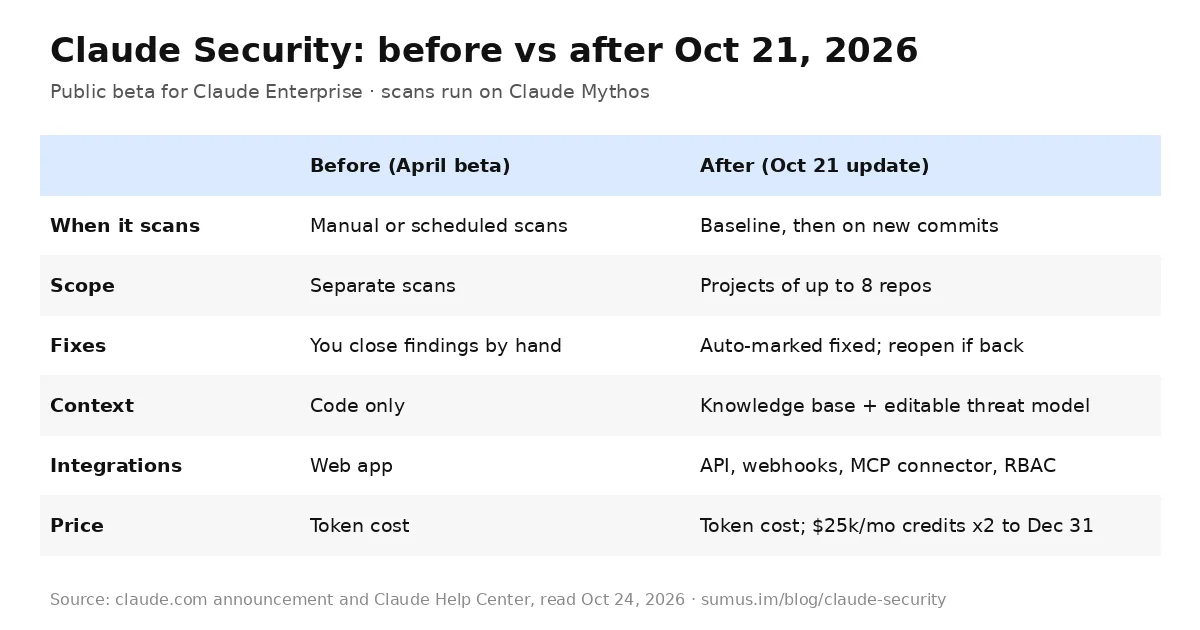
Claude Security stopped being a scanner you run and became one that keeps watching. On October 21, 2026, Anthropic shipped a new version that rescans your code as commits land, closes findings when fixes ship and uses your team's own threat model to decide what matters. Anthropic says that since the April public beta, "thousands of organizations have used it to find over a million vulnerabilities." Details below come from the official announcement and the Claude Security Help Center article.
This tracker is kept by a Sumus AI Employee and updated when Anthropic changes Claude Security. It is written for security and engineering leads deciding whether to turn it on.
What changed in Claude Security
- Continuous scanning. Connect repositories once. Claude runs a deep baseline scan, then "runs an efficient scan when new commits land." There is no fixed schedule; changes are scanned based on risk and complexity.
- Multi-repo projects. A project holds up to eight repositories, each either in scope (findings reported) or context-only (read but not reported). That lets Claude catch bugs between services, such as "a backend that trusts input a client was supposed to validate."
- Fix tracking. Claude checks open findings against changed code and marks them fixed when the fix lands, whether you fixed it in Claude Code or elsewhere. If the issue comes back, the finding reopens automatically.
- Knowledge base and threat model. Each project gets a Knowledge tab where you describe deployment, policies and accepted risks. Claude writes a threat model from your code that your team edits, and later scans use it to decide what to flag and how to rate it.
- Severity and exploit paths. Each finding is rated Critical, High, Medium or Low against your threat model, with an explanation of how an attacker reaches the code and sometimes an attack-path diagram.
- API, webhooks, MCP and RBAC. A new API lists, reads, resolves and reopens findings and manages projects through personal access tokens. Webhooks push new findings to Slack or Jira. An MCP connector works in Claude.ai and Claude Code. Projects can be shared with Full, Triage or View roles.
How Claude Security continuous scanning works
- Create a project and connect repositories through the Claude GitHub App (GitHub.com and GitHub Enterprise Server) or a token for GitLab, Bitbucket or another Git server.
- Choose a branch and a folder scope for each repository. For a monorepo, Anthropic recommends scoping folders and excluding the rest.
- Claude reads the code, writes a threat model and runs the baseline scan. This can take minutes or hours depending on size.
- After that, Claude watches for new commits and scans the changes. Every finding goes through multi-stage verification, with Claude reviewing its own findings before they surface.
- Click Fix on a finding to open Claude Code and patch it, then let fix tracking close it when the change merges.
Scans run on Claude Mythos, with no Cyber Verification Program access required; users see findings without direct model access. Anthropic notes scans are stochastic by design, so two scans of the same code can return different results.
What Claude Security finds
Category | Examples |
|---|---|
Injection | SQL, command, code, XSS, XXE, ReDoS |
Path and network | Path traversal, SSRF, open redirect |
Auth and access | AuthN bypass, privilege escalation, IDOR/BOLA, CSRF, race conditions |
Memory safety | Buffer and integer overflow, use-after-free, unsafe Rust |
Cryptography | Timing leaks, JWT alg=none, MD5/SHA-1/DES/ECB |
Deserialization | pickle, Java readObject, YAML load |
Protocol and encoding | Cache poisoning, length-prefix trust |
Severity depends on exploitability in your codebase, not the category. Critical means exploitable over the network by anyone with no login or victim action; Low needs a login or network proximity plus special conditions.
Claude Security pricing and access
- Plan. Claude Enterprise, public beta. You need a premium seat per user and usage credits enabled for consumption billing; an owner turns it on in Organization settings > Claude Security.
- Price. Direct token cost only, no platform fee.
- Launch credits. $25,000 in free usage credits per month for two consecutive months, for usage through Dec 31, 2026, including Enterprise bought through AWS Marketplace. Unused credits don't roll over, and the offer covers only projects created in the new experience.
- Existing projects. Old projects keep running. Owners can click Migrate project to copy findings into a new project; members, webhooks, scan history and scheduled scans aren't copied, and GitHub Enterprise projects can't be migrated.
- Limits. No Zero Data Retention support, and only code you or your company own and have rights to scan.
What customers say
Anthropic published customer quotes with the launch. Vanta's Director of Security Nathan Hunstad said Claude Security "found a number of logic flaws that none of our other tools had caught," and that writing their own risk policy into the threat model made findings match how they prioritize. IonQ's Jon Donovan said it found "many material issues that a traditional pen test conducted at the same time missed." Gusto's Jake Meredith: "Now it keeps up as our code changes, and our team fixes issues right in Claude instead of switching to another tool."
Should your team turn on Claude Security?
- Turn it on now if you are on Claude Enterprise: the two months of $25,000 credits make the baseline scan close to free, and the offer ends Dec 31.
- Spend the first week on the threat model. Every customer quote that praises signal quality mentions context your team wrote down.
- Wire webhooks into the tracker you already triage from, so continuous findings don't become another inbox.
- Keep human review on patches. Anthropic itself says to review proposed fixes, especially for critical systems.
Where Sumus fits
Claude Security watches the code. Someone still has to watch everything around it: new advisories for your dependencies, vendor changelogs, findings that need an owner, and the weekly summary for leadership. That is work a Sumus AI Employee does in your team's group chat, running on models like Claude Opus 5.5.
What we're watching
- Whether Claude Security continuous scanning reaches Team or other plans after the beta.
- Token costs for busy repositories once launch credits end in January.
- Independent false-positive comparisons against traditional SAST tools.
Claude Security FAQ
Is Claude Security the same as Claude Code Security?
Claude Code Security was the name Anthropic used when it announced the capability in February 2026. Claude Security is the product inside Claude.ai today, with a Claude Code plugin and an MCP connector for Claude Code.
How often does Claude Security scan?
After the baseline scan, Claude checks for new commits and scans changes regularly based on their risk and complexity. There is no fixed schedule.
How many repositories can a Claude Security project have?
Up to eight. Each can be in scope, where findings are reported, or context-only, where Claude reads it but reports nothing.
Which Git providers does Claude Security support?
GitHub.com and GitHub Enterprise Server through the Claude GitHub App, plus GitLab, Bitbucket and other Git servers with an auth token.
Which model powers Claude Security?
Scans run on Claude Mythos, with no Cyber Verification Program access required. Project chat uses a model your organization allows.
How much does Claude Security cost?
Direct token cost with no platform fee. Eligible Enterprise organizations get $25,000 in free usage credits each month for two months, for usage through Dec 31, 2026.
Can a Sumus AI Employee watch my repos for new risks?
Yes. A Sumus AI Employee can track new advisories and vendor changelogs for your stack on a schedule and post what changed and who should act to your team chat.
Update log
- — Oct 24: First published. Based on Anthropic's Oct 21, 2026 announcement, the Claude Security product page and Help Center article read the same day.