
Inception Mercury 3: 1,068 tok/s Diffusion LLM, $0.10/1M
Inception Mercury 3 is a diffusion LLM running at 1,068 tokens/s with a 1M context and $0.10/$0.35 per 1M tokens at launch. Specs, benchmarks, API and limits.
Inception Mercury 3: Speed, Pricing, Benchmarks and API
By Sumus team · Updated Oct 20, 2026 · 6 min read
Quick answers
What is Inception Mercury 3? A diffusion-based large language model (dLLM) that Inception released on October 19, 2026. It writes text by refining many tokens in parallel instead of one token at a time.
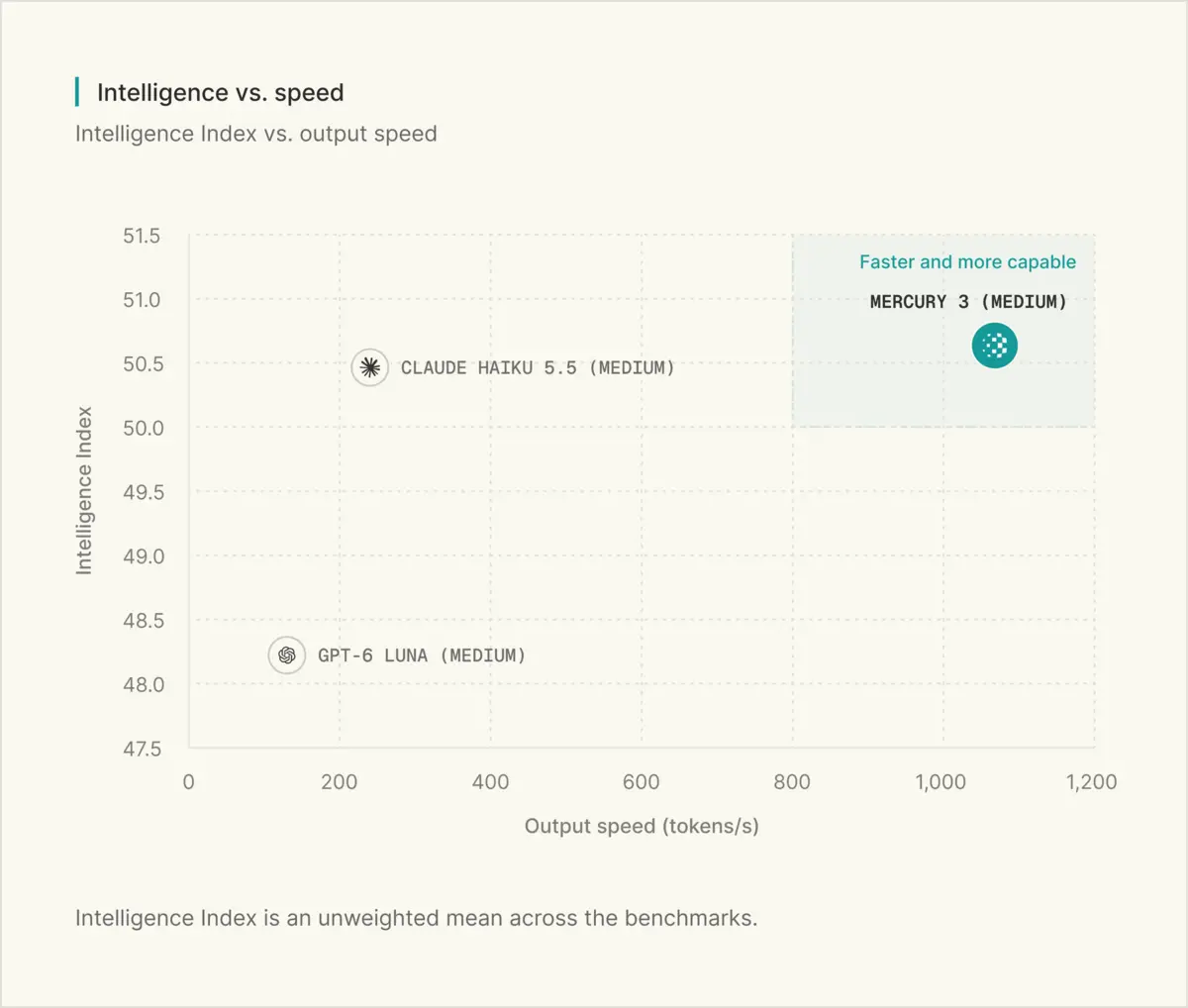
How fast is Mercury 3? 1,068 tokens per second on NVIDIA GPUs, 4–8x faster than GPT-6 Luna and Claude Haiku 5.5.
How much does Mercury 3 cost? $0.10 per 1M input tokens and $0.35 per 1M output tokens during the 50%-off launch promotion. The list price is $0.20 / $0.70, and cached input costs $0.01 per 1M at launch.
Inception Mercury 3 is a fast, cheap, text-only model built for agents, voice and search tools, where waiting on the model is the main cost. It has a 1M-token context window, outputs up to 131,072 tokens, supports tool calling and structured outputs, and runs on an OpenAI-compatible API. New Inception accounts get 100 million free tokens. Inception's launch announcement has the full story; the models page has prices and limits.
Key points:
- Released October 19, 2026, as Inception's flagship model; Mercury 2 and 2.5 are now closed to new users.
- 1,068 tokens/s output speed.
- 1M-token context, up from 260K on Mercury 2.5; max output 131,072 tokens.
- Launch price $0.10 in / $0.35 out per 1M tokens, half the $0.20 / $0.70 list price.
- Available on the Inception API, OpenRouter, Baseten and Vercel.
Inception's launch chart: Mercury 3 sits alone in the "faster and more capable" corner. Source: Inception's launch post on X.
1. Inception Mercury 3 specs at a glance
Table 1 · Sources: Inception docs; OpenRouter; Artificial Analysis for peer speeds. Oct 20, 2026.
Inception hasn't disclosed the parameter count beyond saying Mercury 3 is "more than 40x larger than Mercury 1". There are no open weights; access is through the API.
2. How a diffusion LLM differs from GPT or Claude
GPT, Claude and Gemini are autoregressive models. They predict the next token, append it, and repeat, so a 1,000-token answer takes 1,000 steps one after the other.
A diffusion LLM starts with a rough draft of the whole answer and refines all positions over a fixed number of passes, a process called denoising. Each pass updates many tokens at once, so the model uses the GPU more fully and finishes long outputs in far fewer steps. You can watch it in Inception's chat app with "Diffusion Effect" on: the reply appears as scrambled characters that sharpen into text.
The big question was whether diffusion models keep getting smarter as they scale. Mercury 3 answers it: about 40x more parameters than Mercury 1, roughly 3x higher scores on Inception's standard benchmark set, and the same speed.
3. Mercury 3 speed and benchmarks
Speed in real apps. Launch partners report:
- Octen AI (search on smart glasses): 0.9 s median generation, 2.2 s end-to-end.
- RevisionDojo (tutoring): hints and marked answers in about a second.
- TinyFish AI (web agents): 50% of 50 live Mind2Web tasks completed, well ahead of GPT-6.1-Sol at the same token and step budget.
Benchmarks. At medium settings, Mercury 3 leads 8 of 12 tests against GPT-6 Luna and Claude Haiku 5.5:
Table 2 · Inception benchmark chart, medium settings, Oct 19, 2026.
The headline score on the chart is Inception's own average of 12 benchmarks (including GDPval, SciCode, Tau3-Banking, Terminal-Bench v2.1 and BrowseComp+), now labeled "Model Quality". It is separate from Artificial Analysis's Intelligence Index.
Mercury 3 is strongest at instruction following and agentic coding, and a hair behind on long-context retrieval and longer coding tasks. If your workload is mostly 500K-token document recall, test that first.
What early users are saying on X
- Serafim Batzoglou ran it on his induction benchmark (9% train, 5% holdout), "about par with Gemini 3.5 Flash", and called it "incredibly impressive" for the price.
- Developers described it as strong as an agentic model and "very fast and accurate" on German legal tasks.
- Critics wanted comparisons at high effort, not just medium, and one user measured 7.7x more thinking tokens than Luna on the same task — worth watching on cost.
- Common questions: speed with 200K-token prompts and under heavy concurrency, and open weights (none announced).
4. Mercury 3 pricing
Table 3 · Inception models page, Oct 20, 2026. No end date announced for the launch discount.
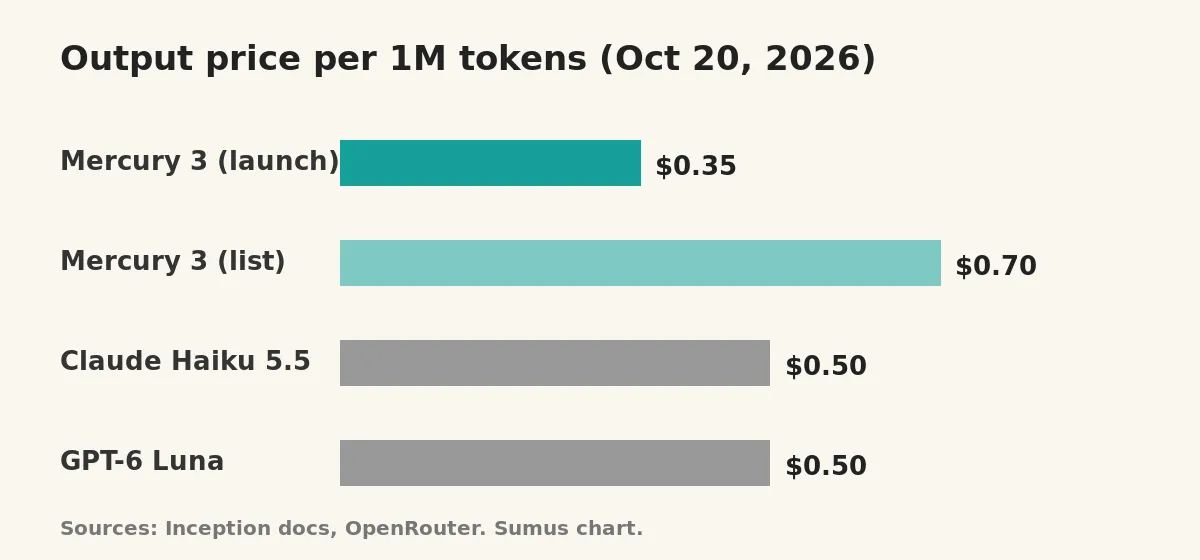
At launch prices, Mercury 3 output is 30% cheaper than Haiku 5.5 or GPT-6 Luna ($0.35 vs $0.50 per 1M) and input is the same. At list price, output is 40% more expensive. The lasting advantage is speed.
Free tier: 100M tokens for new accounts, no card required. Rate limits per minute: Free 1,000 requests / 1M input / 100K output tokens; Pay As You Go 3,000 / 3M / 300K; Enterprise custom.
On Mercury 2 or 2.5? Both are closed to new users. Existing customers with usage before Oct 19, 2026 keep access until Nov 15, 2026; enterprise contracts continue.
5. How to use the Mercury 3 API
The API is OpenAI-compatible: model id mercury-3, base URL https://api.inceptionlabs.ai/v1. With the official Python SDK:
Things to know:
reasoning_effortdefaults tolowon Mercury 3 (Mercury 2/2.5 default tomedium). Useinstantfor voice andhighfor multi-step reasoning.- Temperature runs from 0.5 to 1.0, so you can't set 0.
- Tool calling, structured outputs (
response_format) and streaming work on chat completions. - On OpenRouter the id is
inception/mercury-3. - Inception's docs include setup guides for Claude Code (through a LiteLLM bridge), Cursor, OpenCode, Kilo Code, LangChain, ElevenLabs and Vapi.
6. Mercury 3 limits to know before you switch
- Text only. No image or audio input (image input lives in Mercury Decide, a separate classification model).
- Long context is its weakest area. It trails on MRCR v2 and AA-LCR despite the 1M window.
- Closed model. No open weights or self-hosting outside enterprise deals.
- Launch pricing. The 50% discount has no published end date.
- Narrow temperature range (0.5–1.0) affects deterministic eval pipelines.
7. Where Sumus fits: fast models plus AI teammates in your team chat
Sumus puts a fast model like Mercury 3 to work inside your team chat. Your team and AI teammates share one group chat: you hand off work in plain words, AI teammates bring in other agents for the subtasks, and everyone inspects the results together in the same thread. With Mercury 3 answering in about a second per step, several agents can try different approaches in parallel and you compare the results in minutes.
For example, tell an AI teammate "run our 20 support prompts against Mercury 3 and Haiku 5.5 and summarize where each one fails". It splits the work across agents and posts a side-by-side summary your whole team can review. Coding agents you already run on your machine, such as Claude Code or Codex, join the same chat as teammates.
Put Mercury 3 and a team of AI agents to work in your group chat → Start free in Sumus
What we're watching
- Third-party throughput numbers on OpenRouter and Artificial Analysis.
- When the 50% launch discount ends, and whether that lands before Mercury 2's Nov 15 cutoff.
- Long-context results at scale.
FAQ
Who makes Mercury 3?
Inception (inceptionlabs.ai), based in Redwood City, California. Its Mercury models were the first commercial diffusion LLMs. It's unrelated to "Inception AI", a UAE company.
Is Mercury 3 free to try?
Yes. New Inception Platform accounts get 100 million free tokens without a card, and there's a public chat demo at chat.inceptionlabs.ai.
Is Mercury 3 on OpenRouter?
Yes, as inception/mercury-3, with a 1M context and the same $0.10 / $0.35 launch prices. It's also on Baseten and Vercel AI Gateway.
What happens to Mercury 2 and Mercury 2.5?
Both are closed to new users. Existing non-enterprise customers keep access until Nov 15, 2026; enterprise customers stay on their current agreements.
Can I use Mercury 3 with Sumus?
Yes. Bring the agent you already run on Mercury 3 (for example a Claude Code or Codex setup pointed at Mercury 3) into a Sumus group chat, hand it a task, and it works alongside your team and other AI teammates; everyone sees the result.
Sources
- Inception, Diffusion at Scale: Introducing Mercury 3, Oct 19, 2026.
- Inception, launch post on X, Oct 19, 2026.
- Inception Docs, Models and pricing.
- OpenRouter, inception/mercury-3.
- Also referenced: Inception docs (Quick Start, Reasoning Efforts, Rate Limits), Business Wire, MarkTechPost, Unite.AI, Artificial Analysis, X posts by Stefano Ermon, OpenRouter, Vercel and Serafim Batzoglou.
Update log
- Oct 20, 2026: First version. Prices, context and availability checked against Inception docs and OpenRouter.