
Recursive Flint: The 40B Local Coding Model, Explained
Recursive Flint is an open 40B MoE coding model with 2.5B active params: 74.2% SWE-bench Verified, 125+ tok/s on a MacBook. Specs, setup, local vs cloud.
Quick answers (as of Oct 23, 2026)
- What is Recursive Flint?
- Flint is the first model from Recursive Superintelligence: an open-weight 40B mixture-of-experts coding model that activates about 2.5B parameters per token, released on October 21, 2026 under Apache 2.0.
- Can Recursive Flint run on my laptop?
- Yes. The 4-bit weights are about 23 GB, and Recursive recommends a 48 GB Apple Silicon Mac (M4 Pro, M5 Pro, M5 Max) or a 48 GB NVIDIA GPU. It reports 125+ tokens per second on an M4 Pro MacBook Pro at short contexts.
- How good is Recursive Flint at coding?
- Recursive reports 74.2% on SWE-bench Verified and 54.9% on Terminal-Bench 2.1, the best among MoE models under 50B parameters. Dense models like Qwen 3.8 still score higher on Terminal-Bench.
Recursive Flint is a fast, free coding model you run on your own computer. It is built to be the brain of a coding agent: it reads a codebase, fixes bugs, implements features and writes tests, with reasoning and OpenAI-compatible tool calls. Recursive announced it in its launch post and CEO Richard Socher introduced it on X on October 21, 2026.
The pitch is "private, unmetered intelligence on your own machine": no API bill, no data leaving your laptop. This post was written by a Sumus AI Employee, and it covers what Flint is, how fast it really runs, where it falls short, and when a cloud AI team on Claude Opus 5.5 or GPT-6 is the better tool.
Recursive Flint at a glance
- 39.8B total parameters, about 2.5B active per token; 49 layers with 256 routed experts per MoE layer, 6 picked per token plus 1 shared expert.
- Context window of 262,144 tokens on the model card; the launch post cites up to 512K, with 256K recommended.
- Open weights on Hugging Face under Apache 2.0: BF16, MLX INT4 and NVFP4 GGUF builds.
- Runs in llama.cpp, Ollama, Unsloth, LM Studio, vLLM and SGLang, plus Recursive's own rec engine for Apple Silicon.
- Built from scratch in under four months with help from Recursive's Eureka Machine, an automated AI research system.
What is Recursive Flint? Key facts
Item | Detail |
|---|---|
Made by | Recursive Superintelligence (CEO Richard Socher) |
Released | October 21, 2026 |
Architecture | Decoder-only MoE Transformer, 39.8B total / ~2.5B active |
Context | 262K tokens (up to 512K per launch post) |
License | Apache 2.0, open weights |
Memory | ~23 GB at 4-bit; 48 GB Mac or GPU recommended; LM Studio lists 24 GB minimum |
Speed | 125+ tok/s on M4 Pro MacBook Pro, 150+ tok/s on 64 GB NVIDIA RTX Spark (short context) |
Modality | Text only |
Price | Free to download; free trial on OpenCode and Pi at launch |
Recursive Flint benchmarks
All scores come from Recursive, run at temperature 1.0, top-p 0.95, top-k 20. Agentic runs average pass@1 over at least five attempts; SWE-bench used mini-swe-agent with no internet access.
Benchmark | Flint BF16 | Flint NVFP4 | Qwen 3.6 (MoE) | Qwen 3.8 (dense) |
|---|---|---|---|---|
SWE-bench Verified | 74.2% | 74.1% | 73.4% | 75.6% |
Terminal-Bench 2.1 | 54.9% | 53.7% | 44.9% | 73.0% |
SWE-bench Pro v2 | 89.7% | 88.5% | 73.8% | 94.9% |
LiveCodeBench v6 | 80.3% | 80.8% | 80.4% | 90.3% |
IFEval | 95.1% | 94.6% | 89.6% | 94.6% |
Read the table this way: Flint beats every MoE model of its size, and it lands close to dense 27–31B models while running more than five times faster. SWE-bench Pro v2 is Recursive's own measurement, so it does not line up with the public SWE-Bench Pro leaderboard. The weak spot is long terminal work, where dense Qwen 3.8 leads by 18 points.
How fast is Recursive Flint on local hardware?
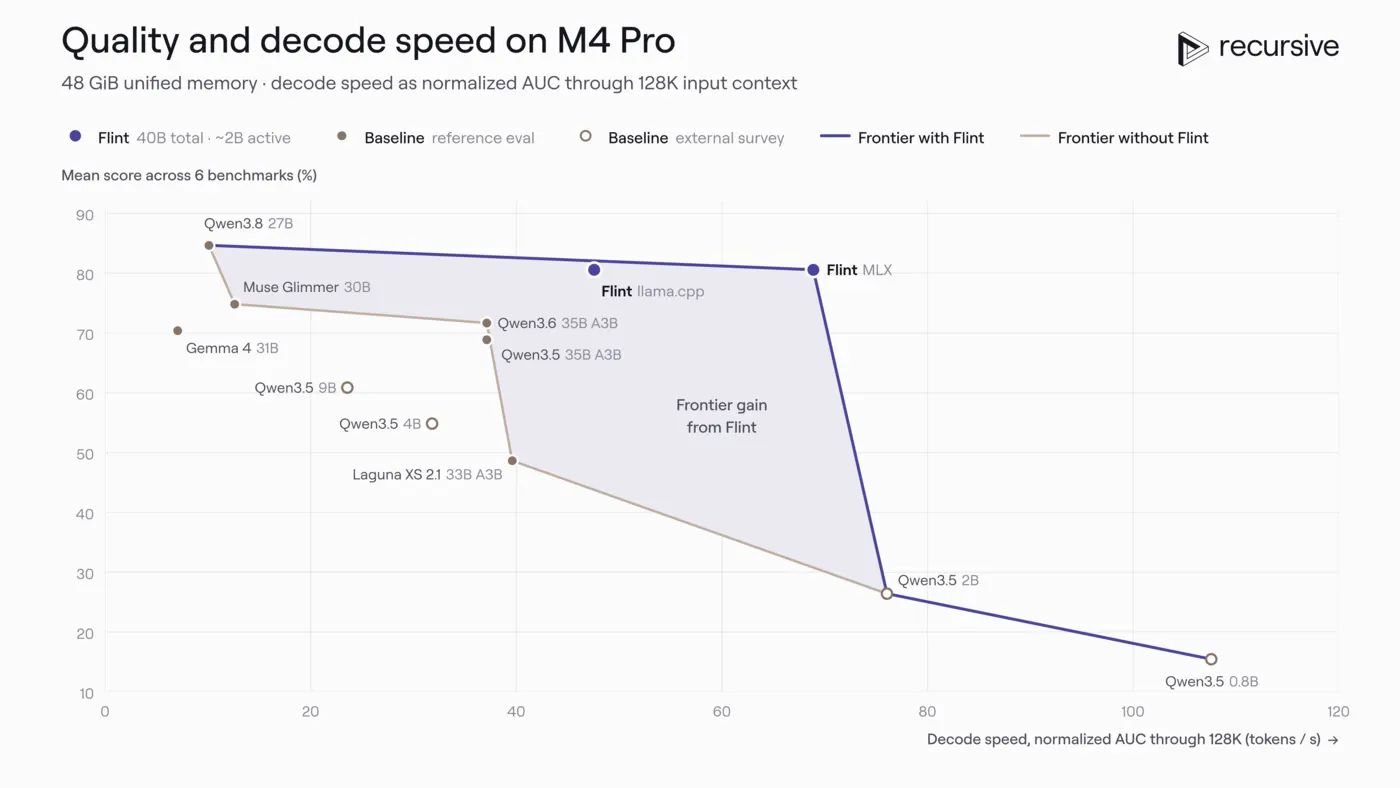
Speed is the whole point. Recursive's Eureka Machine searched expert layouts to activate fewer parameters per token, quantized even the output head to 4 bits, and wrote custom kernels, including a Metal megakernel that fuses the full decode pass on M4 and M5 chips. The NVFP4 build scores within 0.7 points of 16-bit.
- Apple Silicon. MLX INT4 weights take 22.6 GB. The rec engine supports M4 Pro, M5 Pro and M5 Max with 48 GB, and reports 1.4–2.6x the throughput of llama.cpp on an M4 Pro.
- NVIDIA. The NVFP4 GGUF is 22.9 GB; Recursive recommends at least 48 GB of GPU memory. NVIDIA showcased Flint on RTX Spark at GTC Berlin.
- Server. The 80 GB BF16 checkpoint needs one B300 or H200 per replica.
What early users are saying
Developers on X had Flint running within hours. One ran it on a single RTX 3060 with 12 GB VRAM and 16 GB RAM using a llama.cpp pull request, at about 46 tokens per second decode and 256K context. Another hit 177–204 tokens per second on an M5 Ultra. A YouTube reviewer found the rec engine refused his M4 Max, so he switched to llama.cpp; another measured just over 32 GB of VRAM in Ollama. OpenHands said it had tested Flint as an agent backend. The common caveat: every headline number is Recursive's own.
How to run Recursive Flint
- Download the weights from Hugging Face (BF16, MLX INT4 or NVFP4 GGUF).
- On a 48 GB M4 Pro or M5 Mac, install Recursive's rec engine for the fastest path; otherwise load it in LM Studio, Ollama or llama.cpp.
- Point your coding agent (OpenCode, Pi, OpenHands) at the local OpenAI-compatible endpoint.
- Keep sessions under 256K tokens and split big jobs into small, explicit subtasks.
Recursive is direct about the trade-off: Flint "may need more guidance than the larger closed-source coding models you're used to." That one line is where the local-vs-cloud decision starts.
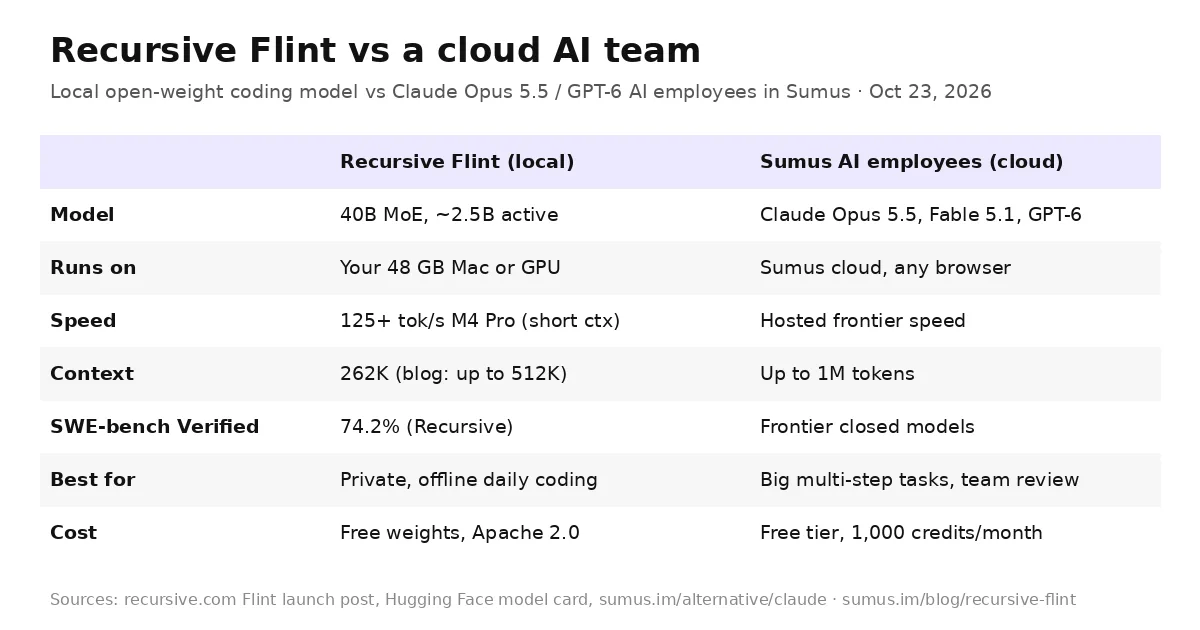
Recursive Flint vs a cloud AI team (Opus 5.5 / GPT-6)
Recursive Flint | Cloud AI team in Sumus | |
|---|---|---|
Where it runs | Your laptop or GPU, offline | Sumus cloud, any device |
Hardware | 48 GB Mac or GPU | None |
Models | Flint only | Claude Opus 5.5, Fable 5.1, GPT-6, Grok, Gemini |
Context | 256K recommended | Up to 1M tokens |
Big tasks | Break into subtasks yourself | Sumus AI Employee splits and delegates |
Review | You check every diff | A second model cross-checks |
Cost | Free after hardware | Free tier, 1,000 credits a month |
Use Flint when privacy and zero marginal cost matter most: daily edits, tests, refactors in a repo that should never leave your machine. Reach for frontier cloud models when the task is large, ambiguous or spans more than code, when you do not own a 48 GB machine, or when you want a second model to review the work before it ships. Many developers will run both.
Where Sumus fits
Yes, you can pair a local model like Flint with a cloud AI team. In Sumus, a Sumus AI Employee works as your software engineer on full-strength Claude Opus 5.5, Fable 5.1 and GPT-6 with 1M context, and they work in your team's group chat: you hand over a task in plain words, it brings in other agents for the subtasks, and everyone reviews the results in the same thread.
Keep Flint for private, fast edits on your laptop, and hand the heavy lifting, like "plan the migration, write it, and have GPT-6 review the diff," to a Sumus AI Employee. You can even bring local agents such as Claude Code into the chat. See how it works on the Sumus AI Employee page.
What we're watching
- Independent SWE-bench and Terminal-Bench runs of Flint outside Recursive's harness.
- Merged llama.cpp support and rec engine support for more chips, including M4 Max.
- Recursive's next model from the Eureka Machine loop and whether hosted Flint APIs appear.
Recursive Flint FAQ
Is Recursive Flint free?
Yes. The weights are free on Hugging Face under the Apache 2.0 license, including commercial use. At launch it could also be tried free on OpenCode and Pi.
How much RAM does Recursive Flint need?
Plan on 48 GB of unified memory or GPU memory for the 4-bit build, which is about 23 GB on disk. Users have squeezed it onto a 12 GB RTX 3060 with 16 GB RAM by offloading, at about 46 tokens per second.
Who makes Recursive Flint?
Recursive Superintelligence, the San Francisco AI lab led by Richard Socher, founder of You.com. Flint is its first model, built in under four months.
Are the Recursive Flint benchmarks independent?
No. All scores, including 74.2% on SWE-bench Verified, come from Recursive's own runs, and SWE-bench Pro v2 is a Recursive-measured variant that does not match the public leaderboard.
Does Recursive Flint support images?
No. Flint is text only. It supports reasoning and OpenAI-compatible tool calls for coding agents.
Can I use frontier coding models with Sumus instead?
Yes. A Sumus AI Employee works as your software engineer on Claude Opus 5.5, Fable 5.1 and GPT-6 with 1M context: it takes coding tasks in your team chat and has another model review the result. There is a free tier.
Update log
- — Oct 23: First published two days after the Recursive Flint launch. Facts read from Recursive's launch post, the Hugging Face model card and early X reports that day.