
Particle-1 (DeepSeek V4.1 Flash): 45% Fewer Tokens, Price & API
Particle-1 is DeepSeek V4.1 Flash post-trained to use ~45% fewer tokens at the same accuracy. How it works, benchmarks, $0.25/$1 price, API and availability.
Quick answers
- What is Particle-1?
- A coding model launched Oct 28, 2026 by Particle, the new company from Mixpanel co-founder Suhail Doshi. It is DeepSeek V4.1 Flash post-trained to finish the same tasks with about 45% fewer tokens.
- Is Particle-1 made by DeepSeek?
- No. Particle built it on top of DeepSeek's open-weight V4.1 Flash 1017 model. Accuracy stays close to DeepSeek; the token bill drops.
- How much does Particle-1 cost?
- OpenRouter lists $0.25 per 1M input tokens, $1 per 1M output and $0.03 for cache reads. Because it writes fewer tokens, the cost per task is about 34–52% lower than base DeepSeek V4.1 Flash.
- How do I use Particle-1?
- Get a key at platform.particle.ai and call model particle-1 at api.particle.ai/v1 with any OpenAI-compatible SDK, or use particle-ai/particle-1 on OpenRouter.
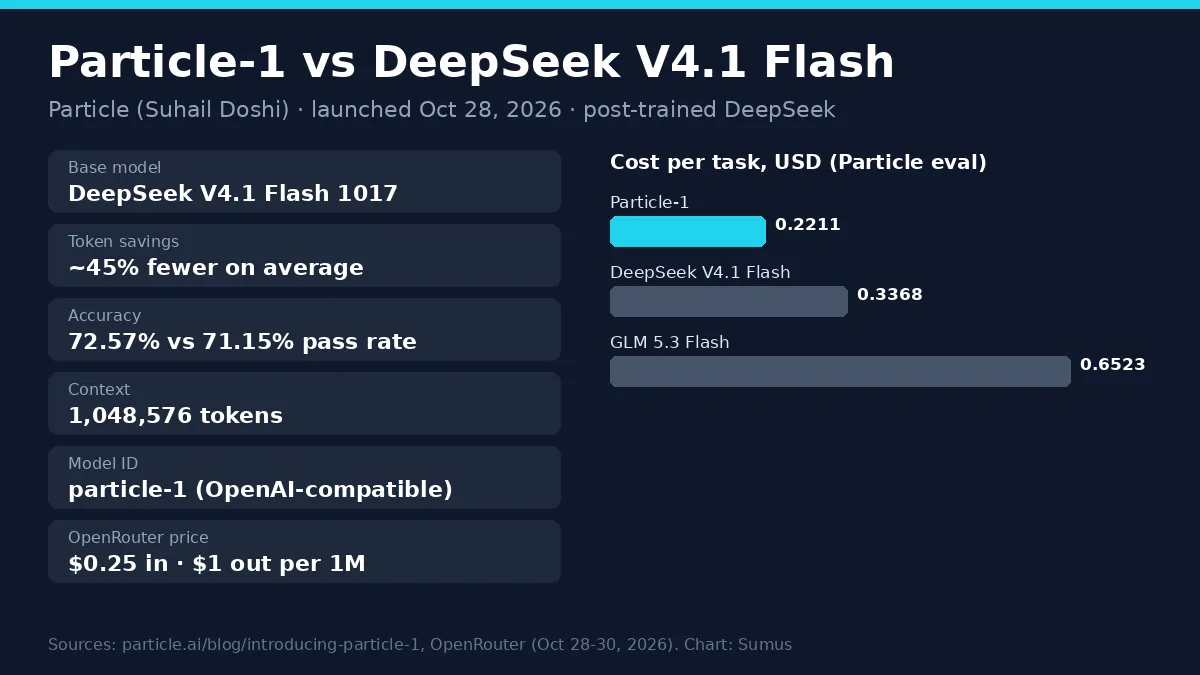
Particle introduced Particle-1 on October 28, 2026. Particle-1 is DeepSeek V4.1 Flash trained to think less and stop sooner: it uses about 45% fewer tokens on average with the same accuracy, so coding agents cost less and finish faster.
Founder Suhail Doshi, who co-founded Mixpanel and built Playground, announced it on X as "live now". The first release is aimed at software engineering: terminal work, React apps, data engineering and long codebase tasks.
1. Particle-1 at a glance
Item | Particle-1 |
|---|---|
Maker | Particle (Suhail Doshi) |
Launched | Oct 28, 2026 |
Base model | DeepSeek V4.1 Flash 1017 (open weights) |
Training | RL with a reward for solving tasks in fewer tokens; rank-64 LoRA |
Token savings | ~45% on average; 28.4–52.2% fewer output tokens per benchmark |
Context | 1,048,576 tokens, text and image in |
Max output | 131,072 tokens |
API | api.particle.ai/v1 (OpenAI-compatible), OpenRouter |
Price (OpenRouter) | $0.25 in / $1 out / $0.03 cache read per 1M |
2. How Particle-1 saves ~45% of DeepSeek tokens
Particle trained the model in its own reinforcement-learning environments. The reward is simple: solve the task, and use fewer tokens for reasoning and tool calls. Only a small LoRA adapter, about 1.25% of the model's parameters, was trained.
Comparing the same tasks where both models passed, Particle found four habits that changed:
- Less thinking for the same steps. Most savings, about 90% on three benchmarks, come from shorter reasoning.
- Stop when done. Final checks shrank a lot: in one Git task, two confirmation calls dropped from 11,445 to 1,765 tokens.
- Fewer try-and-fix loops. One build task went from 18 model calls to 12.
- Start editing sooner. In a ReactBench task Particle-1 made its first patch on call 12 instead of call 27.
3. Particle-1 benchmarks
Across Terminal-Bench 2.1, ReactBench, ADE Bench and DeepSWE 1.1, Particle-1 used 28.4–52.2% fewer output tokens and cost 34.4–51.6% less per task than DeepSeek V4.1 Flash. Pass rates stayed inside the base model's confidence range.
Model | Cost per task | Output tokens per task | Pass rate |
|---|---|---|---|
Particle-1 | $0.2211 | 59,580 | 72.57% |
DeepSeek V4.1 Flash | $0.3368 | 83,246 | 71.15% |
GLM 5.3 Flash | $0.6523 | 98,155 | 66.82% |
General skills held up too: GPQA Diamond 90.40% (DeepSeek 90.91%), MMLU 86.08% (85.98%), Tau Airlines 86.00% (88.00%). On a legal contract-review test outside its training, Particle-1 used 24.6% fewer tokens and passed all eight reports, while the base model passed 62.5%.
4. Particle-1 price vs DeepSeek
Particle-1 | DeepSeek V4.1 Flash | |
|---|---|---|
Particle launch post (per 1M) | $0.30 in / $1.20 out / $0.006 cached | Same rates |
OpenRouter list (per 1M) | $0.25 / $1 / $0.03 cache | Varies by provider |
DeepSeek official API | — | $0.30 / $1.20 peak, half off-peak |
Tokens per task | ~45% fewer | Baseline |
The point is not a lower token price. Particle charges about what DeepSeek charges. You save because the model simply writes less. If your agent harness caches less than Particle's test setup, your savings may differ, so measure cost per task on your own jobs.
5. How to use Particle-1
- Sign up at platform.particle.ai and create an API key (starts with pai-).
- Point any OpenAI-compatible SDK at https://api.particle.ai/v1.
- Set model to particle-1. Reasoning is on by default (high); set reasoning_effort to none to turn it off.
- Send prompt_cache_key on long agent sessions to keep caching high.
- Or call particle-ai/particle-1 on OpenRouter with the key you already have.
6. Availability and limits
Particle-1 is live now on the Particle API and OpenRouter, with one provider behind it. Early OpenRouter uptime has been shaky, so add a fallback model in production. Weights are not released. The first version is tuned for coding; Particle says other domains come next.
7. Where Sumus fits
Yes, you can use cheap, token-light models like Particle-1 and DeepSeek next to Claude and GPT. In Sumus, each model works as an AI employee in one team chat. Let a fast DeepSeek-class model draft the code, have Claude review the diff, and keep your team's sign-off in the same thread. You spend top-model tokens only where they matter.
What we're watching
- Independent token and accuracy tests from Artificial Analysis.
- Open weights or more providers for Particle-1.
- Particle models beyond coding.
FAQ
Who makes Particle-1?
Particle, a new AI company founded by Suhail Doshi, co-founder of Mixpanel and founder of Playground. It is not an official DeepSeek release.
What base model is Particle-1?
DeepSeek V4.1 Flash 1017, DeepSeek's open-weight model released Oct 17, 2026.
Is Particle-1 open source?
Not yet. It is available only through the Particle API and OpenRouter.
What is Particle-1's context window?
1,048,576 tokens, with up to 131,072 output tokens. It reads text and images.
Can I use Particle-1 with Sumus?
Yes, Sumus puts cheap and top AI models in one team chat, so a DeepSeek-class model can draft and Claude or GPT can review.
Sources
- Particle, Introducing Particle-1, Oct 28, 2026.
- Particle API docs, docs.particle.ai, read Oct 30, 2026.
- OpenRouter, particle-ai/particle-1, read Oct 30, 2026.
- Suhail Doshi on X, Oct 28, 2026.
Update log
- — Oct 30: First published. Particle-1 launched Oct 28, 2026 on DeepSeek V4.1 Flash; ~45% fewer tokens.