
DeepSeek Superagent: What dsh-superagent Is and How It Works
DeepSeek Superagent (dsh-superagent) is an open-source Router-Worker coding agent released Nov 1, 2026. p95 15.7 vs 29.5 min, setup and limits.
Quick answers
- What is DeepSeek Superagent?
- DeepSeek Superagent (dsh-superagent) is an open-source coding agent from the DeepSeek Harness team, released Nov 1, 2026. It watches one GitHub repo, takes requests from allowed people, and answers with work such as a pull request.
- Is DeepSeek Superagent a product?
- No. DeepSeek calls it a research prototype (v0.1.0, MIT license), not an official DeepSeek product. You run it yourself as a DeepSeek Harness profile.
- How is DeepSeek Superagent different?
- One long-running Router talks to people and hands each task to its own Worker session. In DeepSeek's test, p95 task time was 15.7 minutes vs 29.5 for one session with subagents.
- Which model does DeepSeek Superagent use?
- Whatever model your Harness profile is set to, such as DeepSeek V4.1 Flash.
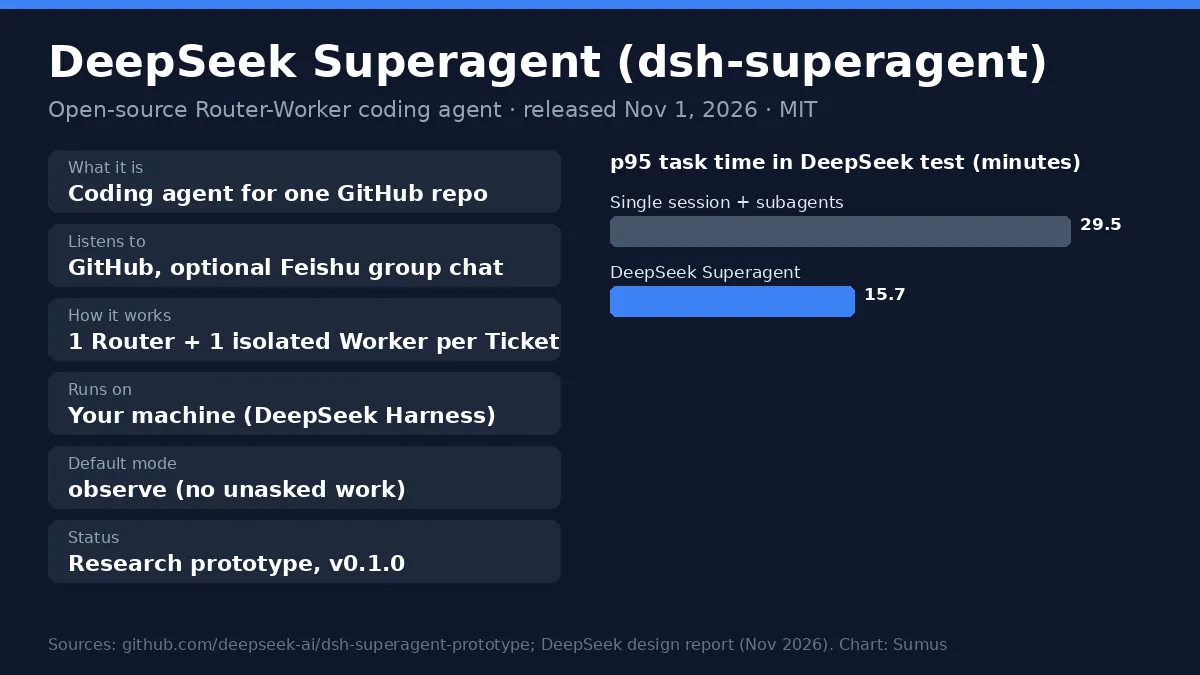
DeepSeek Superagent is DeepSeek's take on an always-on AI agent for a whole team, not just one person. On Nov 1, 2026 the DeepSeek Harness team put the dsh-superagent prototype on GitHub under the MIT license, together with a design report called "Exploring Super-agent Design: Towards a More Autonomous Agent System".
The idea behind DeepSeek Superagent is simple. Today most agents treat one chat session as the unit of work, and a person can only follow 3 to 5 sessions at once. So human attention, not the model, becomes the limit. DeepSeek Superagent tries to fix that by taking work from a group, running many tasks in parallel, and only speaking up when someone must act.
DeepSeek Superagent at a glance
Item | Detail |
|---|---|
Name | dsh-superagent (DeepSeek Superagent) |
Made by | DeepSeek Harness team |
Released | Nov 1, 2026, v0.1.0 |
License | MIT, open source |
What it does | Coding agent for one GitHub repository |
Listens to | GitHub, and optionally Feishu group chats |
Runs on | Your own machine, as a DeepSeek Harness profile |
Status | Research prototype, not an official product |
How DeepSeek Superagent works
DeepSeek Superagent has two layers. A Router runs all the time. It reads new events from GitHub or Feishu, decides if a message asks for real work, and keeps the conversation going. When it sees a real request from an allowed person, it opens a Ticket.
Each Ticket gets its own Worker: a separate agent session with its own folder. The Worker does the job and posts the result back in the place the request came from, often as a pull request. Later comments on that pull request reach the same Worker, so nobody has to mention the agent again. A small web panel lists only the things that need a person.
- Source and Trigger: GitHub or Feishu events come in.
- Eval: the Router decides if a batch of events asks for new work.
- Ticket: one unit of allowed work, with a fixed note on why it may go ahead.
- Worker: an isolated session that does the work and reports back.
- Subscription: follow-up comments go to the right Worker.
Shell commands move to the background after 5 seconds, so a Worker can still read new messages while a long build runs. If a job stops halfway, it can restart with a recovery note.
DeepSeek Superagent rules: ask first, speak less
The README sums up the DeepSeek Superagent way of working in one line: take as little human attention as possible, and give as much value as possible. The agent confirms once, stays quiet while it works, and writes again only with a result, a question or a failure.
Unasked work is off by default. DeepSeek Superagent has three modes: off, observe and auto. In observe mode, the default, it only writes down what it would have picked up on its own. A team has to switch on auto before the agent starts work nobody asked for.
DeepSeek Superagent test results
DeepSeek tested the design with fake group-chat and GitHub CI streams of about 300 messages each, with about 20 real work requests mixed in. Each setup ran 5 times.
Setup | p50 task time | p95 task time |
|---|---|---|
DeepSeek Superagent (Router + Workers) | 12.4 min | 15.7 min |
One session + subagents | not given | 29.5 min |
The baseline was slow for a plain reason: with a neutral prompt, the single agent called a subagent 0 times in 5 runs, so it did every job one by one. As messages rose from about 1 to 40 per minute, the DeepSeek Superagent Router grouped them into bigger batches, and its reply time only went from 2.5 to 3.9 seconds. Keep in mind these are synthetic tests with simulated tools; real coding quality was not measured.
How to try DeepSeek Superagent
- Install DeepSeek Harness and create a profile just for the agent.
- Check the needs: Node.js 22.19+ or 24+, git 2.32+, Python 3.8+, tmux and GitHub CLI 2.48+.
- Ask your coding agent: "Read SETUP.md in this repository and set up dsh-superagent with me." It asks one short question at a time and then installs everything.
- Point it at one GitHub repo and, if you want, a Feishu group.
- Keep it in observe mode first and read what it would have done.
One warning: DeepSeek Superagent runs with full access as your OS user. Put it in a VM or a separate account before you let it touch real code.
DeepSeek Superagent vs other team agents
GitHub Copilot's cloud agent, Claude Code Action and Codex can all take work from GitHub or Slack. What makes DeepSeek Superagent different is the always-on Router plus one isolated session per task, and the strict rule about when to speak. The catch: it is a prototype for one repo, you host it yourself, and setup takes real work.
Want a DeepSeek Superagent for your team, ready today?
Yes, you can get the same kind of team agent without running a prototype. Sumus is a group chat where people and AI teammates work in the same thread. You give a brief to one AI teammate; it plans the job, brings in other AI teammates for the parts, works in parallel and posts the result back for your team to check. Each teammate can run on the model you pick, including DeepSeek, Claude, GPT or Gemini, so you get a DeepSeek-powered agent in your team chat in a few clicks.
FAQ
Is DeepSeek Superagent free?
Yes. The code is free under the MIT license. You still pay for the model calls your Harness profile makes.
Does DeepSeek Superagent work with Slack?
Not out of the box. The prototype listens to GitHub and Feishu; the cookbook shows how to add a new Source.
Is DeepSeek Superagent the same as DeepSeek's internal agent?
No. DeepSeek says the public code was adapted for release and some ideas in the report, like an outside watchdog, are not built yet.
Can DeepSeek Superagent do work without being asked?
Only if your team allows it. The default observe mode just records what it would have done.
Is DeepSeek Superagent safe to run?
Run it in isolation. It has full OS-user access, so use a VM or a separate machine account.
Sources
- DeepSeek: dsh-superagent-prototype on GitHub
- DeepSeek design report "Exploring Super-agent Design: Towards a More Autonomous Agent System", Nov 2026; MarkTechPost and r/DeepSeek coverage, Nov 1, 2026
Update log
- — Nov 3: First published. DeepSeek Superagent prototype released on GitHub on Nov 1, 2026.