
OpenAI Pando: The Git Backend Built for Codex Agents
OpenAI Pando is the Git backend behind OpenAI's monorepo: ~80% faster pushes, nearly 1 PB a day, built in 10 weeks with Codex. Is it available? What it costs.
Quick answers
- What is OpenAI Pando?
- OpenAI Pando is a new Git backend that OpenAI built for its own monorepo. It was announced on Nov 2, 2026 in the post "Scaling Git at OpenAI" and now runs all development there.
- Why did OpenAI build Pando?
- Codex agents made commits grow so fast that the old setup broke down, with reliability at times under 90%. OpenAI Pando cut median push latency by nearly 80% and serves almost 1 petabyte of Git data a day.
- Can I use OpenAI Pando?
- Not yet. OpenAI Pando is internal and not open source. Greg Brockman says OpenAI is thinking about offering it to others and asked interested teams to reach out.
- How much does OpenAI Pando cost?
- There is no price. OpenAI Pando is not a product you can buy today.
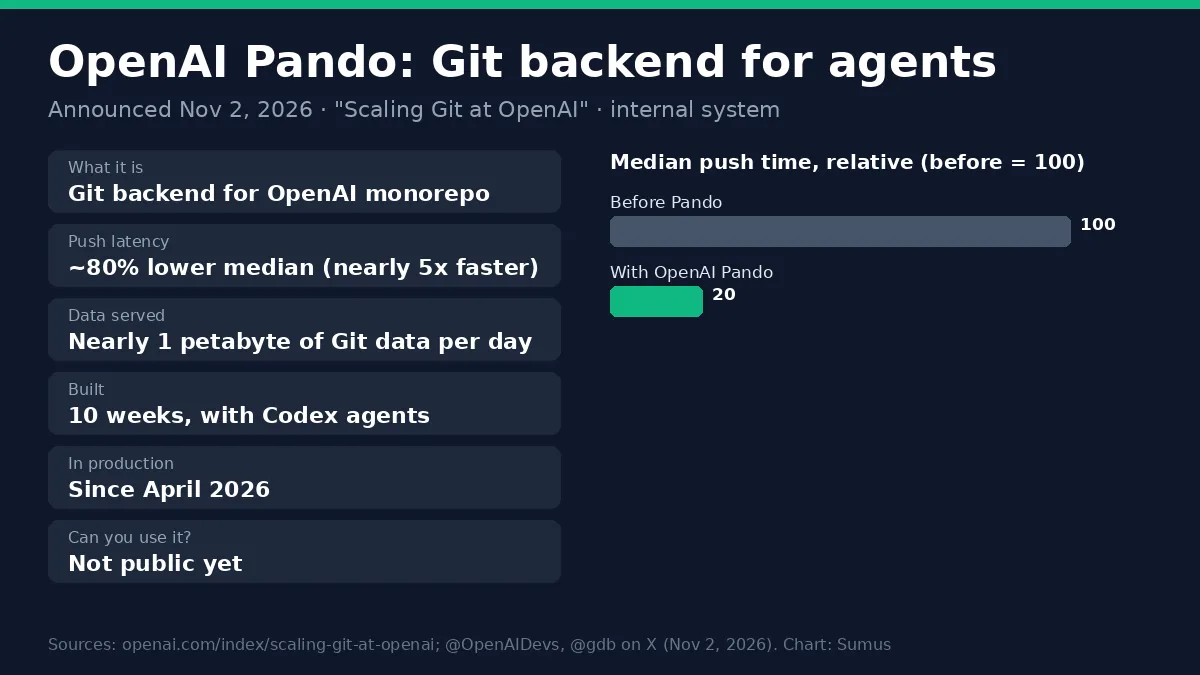
OpenAI Pando is the Git backend OpenAI built because its AI agents were pushing more code than Git servers could handle. On Nov 2, 2026 OpenAI's engineering team published Scaling Git at OpenAI, written by Aaron Friel, Taylor Blau and Ted Nyman. It explains how OpenAI Pando works and why it was needed.
Note the name: this is OpenAI Pando, the source-control system, not the Pando tree, the Pando app or any other Pando. Here is what it does, the numbers, and whether you can get it.
OpenAI Pando at a glance
Item | Detail |
|---|---|
What it is | A Git-compatible backend for very large monorepos |
Made by | OpenAI engineering (Aaron Friel, Taylor Blau, Ted Nyman) |
Announced | Nov 2, 2026 |
In production | Since April 2026; runs all of OpenAI's monorepo |
Push speed | Median push latency down nearly 80% (about 5x) |
Scale | Nearly 1 petabyte of Git data per day |
Built in | 10 weeks, mostly by Codex agents |
Availability | Internal only; not open source; no price |
Why OpenAI needed Pando
Codex changed how OpenAI writes code. One engineer now has several changes ready for CI at once, and each push can start several jobs that fetch the same commit. OpenAI's chart shows commits on master growing far faster than its own base-case plan, with reports putting the jump at about 2,442% from Q1 2024.
From late 2025 the old system struggled: slow fetches, slow pushes, failed merges, and reliability that sometimes fell below 90%. OpenAI had two choices. Drop Git, or keep Git and rebuild the server side. OpenAI Pando is the second choice, so engineers and agents keep using plain git push and git fetch.
How OpenAI Pando works
Big Git services usually keep every branch in one strict order. That means a push to one branch can wait on a push to a totally different branch. OpenAI Pando drops that rule.
- Each branch moves on its own. Pando uses causal consistency: updates to one ref are strictly ordered, but unrelated branches do not wait for each other. Clients only clash when they push to the same branch at the same time.
- Packfiles live in blob storage. Every push is saved as an unchangeable pack, and a metadata store records each ref version. Both scale out across machines.
- The same bytes go to many readers. Instead of building a custom pack for every client, OpenAI Pando reuses packs and serves them from regional caches, with over 99% of bytes coming from cache.
- Background compaction. Small packs (L0) are merged into bigger covers over time, up to L4 today, so a client that is far behind still gets a small download.
The trade-off is small in practice: a reader looking at many branches at once may see them at slightly different moments. OpenAI says people and agents care about the order of one branch, not the whole repo.
OpenAI Pando results
Metric | OpenAI Pando result |
|---|---|
Median push latency | Nearly 80% lower (about 5x faster) |
Data served | Nearly 1 PB per day; peak above 57 TB in one hour |
Cache hit rate | Over 99% of bytes |
Network | Standard cloud VMs fill 10 Gbps links on clone and fetch |
Downtime to switch | None; it first ran as a read and write-through proxy |
How OpenAI built Pando with Codex
OpenAI Pando went from kick-off to production in 10 weeks. One engineer designed the core, teams of Codex agents wrote much of the code, and a handful of engineers deployed it. Agents running GPT-6 Astra also wrote Lean and TLA+ specs to hunt for bugs, next to a Git conformance suite and simulation tests.
OpenAI also sends fixes back to upstream Git, for example cleaning up after an interrupted packfile download, and ships its own Git build to developer machines and the ChatGPT desktop app.
Is OpenAI Pando available, and what does it cost?
No public release, no open-source code and no price yet. OpenAI President Greg Brockman wrote on X that Pando can scale to very large monorepos, and that OpenAI is considering offering it to others. OpenAI's post adds that it is exploring other uses, including workloads where many agents work together on a shared Git repo. Treat any talk of a Pando product or pricing as a rumor until OpenAI announces it.
What OpenAI Pando means for teams using agents
The big lesson from OpenAI Pando: once agents do real work in parallel, the hard part is no longer writing code. It is keeping many workers in sync and keeping people in the loop. Most teams will never need a petabyte a day, but they do need one place where people and agents share the same context.
Yes, Sumus gives you that today. Sumus is a group chat where your team and AI teammates work in one thread. Give a brief to one AI teammate, it brings in others to work in parallel, and the results come back in the same chat for your team to review.
FAQ
Is OpenAI Pando open source?
No. OpenAI shares Git fixes upstream, but the OpenAI Pando backend itself is not open source.
Does OpenAI Pando replace GitHub?
No. OpenAI Pando is a server backend for OpenAI's own monorepo. It keeps the normal Git client and protocol.
Who built OpenAI Pando?
OpenAI engineers Aaron Friel, Taylor Blau and Ted Nyman wrote the post; Codex agents wrote much of the code.
When did OpenAI Pando go live?
It started serving production traffic in April 2026 and was announced on Nov 2, 2026.
How do I get access to OpenAI Pando?
There is no sign-up. Greg Brockman asked teams interested in using it to contact OpenAI.
Sources
- OpenAI: Scaling Git at OpenAI
- Greg Brockman on X; @OpenAIDevs on X, Nov 2, 2026
Update log
- — Nov 3: First published after OpenAI's Nov 2 post on Pando.