
GDPx Benchmark: Scores, Leaderboard and What It Measures
The GDPx benchmark from SemiAnalysis tests AI agents on 206 real tasks in 11 fields. Claude Opus 5.5 leads at 12%, Gemini 4 Carbon 10.9%, GPT-6 Astra 9.6%.
Quick answers
- What is the GDPx benchmark?
- GDPx is a new AI agent benchmark from SemiAnalysis, released Nov 2, 2026. It has 206 long, realistic work tasks in 11 high-value fields such as chip design, finance, legal and biology.
- Which model leads the GDPx benchmark?
- Claude Opus 5.5, with a GDPx benchmark score of 12.0%. Gemini 4 Carbon is second at 10.9% and GPT-6 Astra third at 9.6%.
- Why are GDPx benchmark scores so low?
- The tasks are hard on purpose: each one comes with a real work setup, up to 8 hours, and strict grading. In finance and legal, every model scores zero under the main pass/fail grading.
- Which model is best value on the GDPx benchmark?
- Gemini 4 Carbon: 10.9% at $16.29 per task, about a third of Opus 5.5's $51.41. DeepSeek 4.1 Flash gets 5.4% for $0.94 per task.
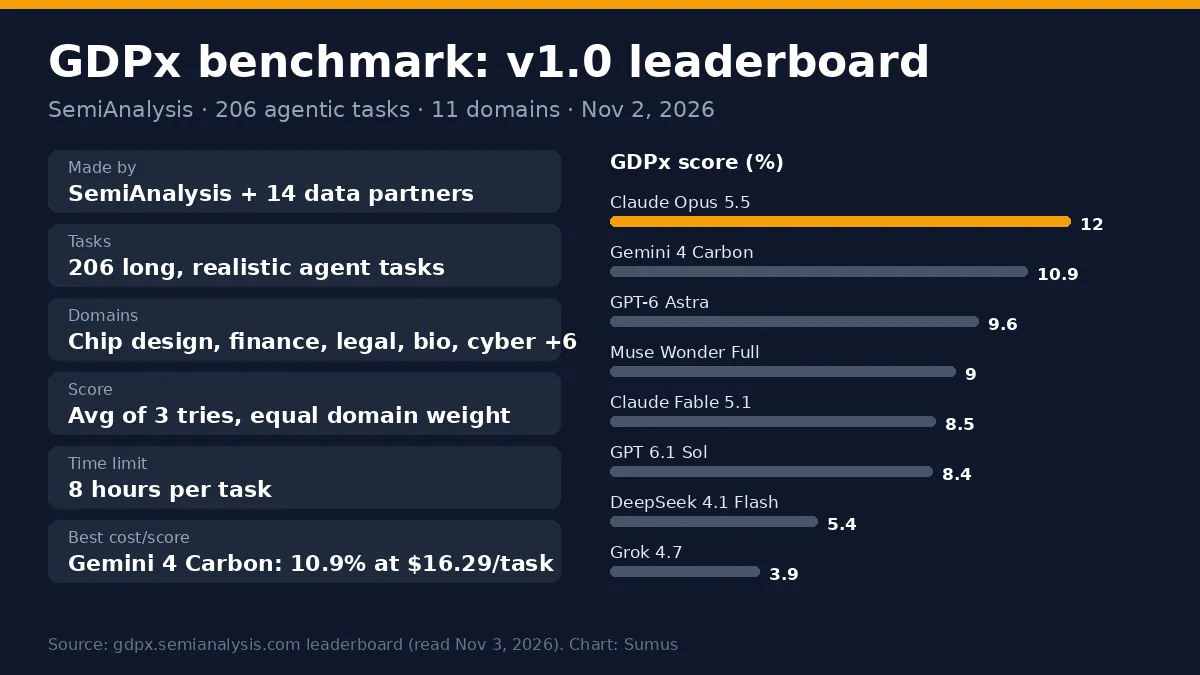
The GDPx benchmark is the new hardest test for AI agents, and the best model only gets 12%. SemiAnalysis launched the GDPx benchmark on Nov 2, 2026, with a public leaderboard and a long write-up by Max Kan, Andrew Megalaa and Dylan Patel. Claude Opus 5.5 is first, but it still fails about 88% of the work.
The GDPx benchmark is built to answer one question: can an AI agent do the kind of long, expert work that will bring in the first trillion dollars of AI revenue? Below is what it measures, the full scores, cost per task, and what it means when you pick a model.
What the GDPx benchmark measures
The GDPx benchmark has 206 tasks across 11 domains, made with 14 expert data partners. SemiAnalysis picked fields where frontier AI can pay off big, and skipped areas like government, real estate and insurance on purpose.
- Chip design (Aria, Arcverex, Ergodex) and hardware design (Beautiful Machines)
- Cybersecurity (Arithmetic) and alignment (Fleet)
- Biology (LatchBio) and materials science (ValenceForge, Emulated)
- Finance (Living Context), legal (Chakra) and quant trading (Third Moment)
- Software engineering (Datacurve) and recursive self-improvement (Extrapolate)
Every task ships with a real work setup, not just a prompt. One example: the 24 finance tasks rebuild a private-equity deal where a fund buys about 62% of a snack maker for $880 million plus an earnout, across about 4,000 files.
GDPx benchmark leaderboard (v1.0)
Rank | Model | GDPx score | Cost per task |
|---|---|---|---|
1 | Claude Opus 5.5 | 12.0% | $51.41 |
2 | Gemini 4 Carbon | 10.9% | $16.29 |
3 | GPT-6 Astra | 9.6% | $53.99 |
4 | Muse Wonder Full (Meta) | 9.0% | no price |
5 | Claude Fable 5.1 | 8.5% | $67.16 |
6 | GPT 6.1 Sol | 8.4% | $9.80 |
7 | Claude Sonnet 5.5 | 8.2% | $45.27 |
8 | Gemini 4 Argon | 7.3% | $12.79 |
9 | Muse Wonder (Meta) | 6.8% | $15.63 |
10 | DeepSeek 4.1 Flash | 5.4% | $0.94 |
11 | GPT-6 Luna | 5.1% | $0.92 |
12 | Grok 4.7 | 3.9% | $16.34 |
13 | GLM 5.3 | 2.7% | $11.79 |
The gap at the top is small. Opus 5.5's lead over Gemini 4 Carbon is about two tasks out of 206, as several people pointed out on X. Gemini 4 Carbon is also not open to everyone yet.
How GDPx benchmark scores are worked out
- Each model gets 3 tries per task; the GDPx benchmark score is the average pass@1.
- All 11 domains count the same, and so does each partner inside a domain.
- Tasks use pass/fail or partial grading, depending on the field.
- Each task has a default time limit of 8 hours.
- Models run in their own tool: Claude Code for Opus 5.5, Codex for GPT-6 Astra, Antigravity for Gemini 4 Carbon, with OpenCode as the fallback.
SemiAnalysis also checked its own tasks hard. Every partner had to pass automated QA on the first try. The same QA flags nearly 50% of Terminal Bench 4.0 tasks as broken, which is part of the pitch for the GDPx benchmark.
GDPx benchmark results by domain
- Claude Opus 5.5 is the best all-round model and wins quant trading, hardware design and chip design.
- Gemini 4 Carbon is the best biology model and narrowly wins software engineering.
- GPT-6 Astra wins recursive self-improvement and materials science.
- Muse Wonder Full is the best cyber model by a clear margin.
- In finance and legal, every model scores zero on pass/fail grading, so those show partial scores.
- In quant trading, 70 of 111 graded runs did worse than the simple strategy they were asked to beat.
SemiAnalysis notes that Opus 5.5 and GPT-6 Astra lose points in cyber, biology and alignment because their safety filters block some work. So their real skill may be a bit higher than the GDPx benchmark score shows.
GDPx benchmark vs GDPval
The GDPx benchmark is meant to replace OpenAI's GDPval (Sept 2025), still the most cited general benchmark on model launch cards. SemiAnalysis says GDPval tasks hand the model all the context in the prompt and never make it explore, and that human experts only agreed with each other 71% of the time on its gold set. In the GDPx benchmark, the agent has to find things on its own, like a real worker.
What the GDPx benchmark means for picking a model
The GDPx benchmark shows there is no single best model for every job. Opus 5.5 is best overall, Gemini 4 Carbon gives the most score per dollar, GPT-6 Astra wins in research-heavy fields, and cheap models like DeepSeek 4.1 Flash and GPT-6 Luna cost under $1 a task. A smart team uses the right model for each part of the work.
Yes, you can do that today in Sumus. Sumus puts Claude Opus 5.5, GPT-6, Gemini, Grok and DeepSeek in one chat. Give the hard thinking to Opus, have a GPT or Gemini teammate check the result line by line, and send quick lookups to a cheap model. Different models catch different mistakes.
FAQ
Who made the GDPx benchmark?
SemiAnalysis, the chip and AI research firm led by Dylan Patel, with 14 data partners. It launched on Nov 2, 2026.
How many tasks are in the GDPx benchmark?
The GDPx benchmark has 206 tasks across 11 domains in version 1.0.
Is Gemini 4 Carbon better than Claude Opus 5.5 on the GDPx benchmark?
No, it scores 10.9% vs 12.0%, but it costs about a third as much per task.
How does Grok 4.7 do on the GDPx benchmark?
Grok 4.7 scores 3.9%, 12th of 13 models, at $16.34 per task.
Can I see GDPx benchmark tasks?
Yes, some public tasks and per-domain results are on gdpx.semianalysis.com; most tasks stay private to keep the test clean.
Sources
- GDPx leaderboard, SemiAnalysis
- SemiAnalysis: GDPx, measuring frontier model capabilities
- SemiAnalysis launch thread on X, Nov 2, 2026; Unite.AI coverage
Update log
- — Nov 3: First published with the GDPx v1.0 leaderboard (13 models).