
Muse Ember: Meta's Cheapest Model, Price & Benchmarks
Muse Ember is Meta's smallest model, out Nov 9, 2026: $0.10/$0.50 per 1M tokens, 1M context, Haiku 5.5-level score at a third of the cost per task.
Quick answers
- What is Muse Ember?
- Muse Ember is Meta's smallest and cheapest AI model, released November 9, 2026 as muse-ember-1.0. It is built for the small steps agents repeat all day: tool calls, coding subtasks, routing, extraction and long document parsing.
- How much does Muse Ember cost?
- $0.10 per million input tokens, $0.004 per million cached input tokens and $0.50 per million output tokens, with a 1M-token context window and up to 512K output tokens.
- Is Muse Ember better than Claude Haiku 5.5?
- On cost, yes. Muse Ember scores 36 on the Artificial Analysis Intelligence Index, the same as Claude Haiku 5.5 (max), at about $0.14 per task against $0.41.
- Where can I use Muse Ember?
- On the Meta Model API and in Muse Code today, and on Vercel AI Gateway as meta/muse-ember.
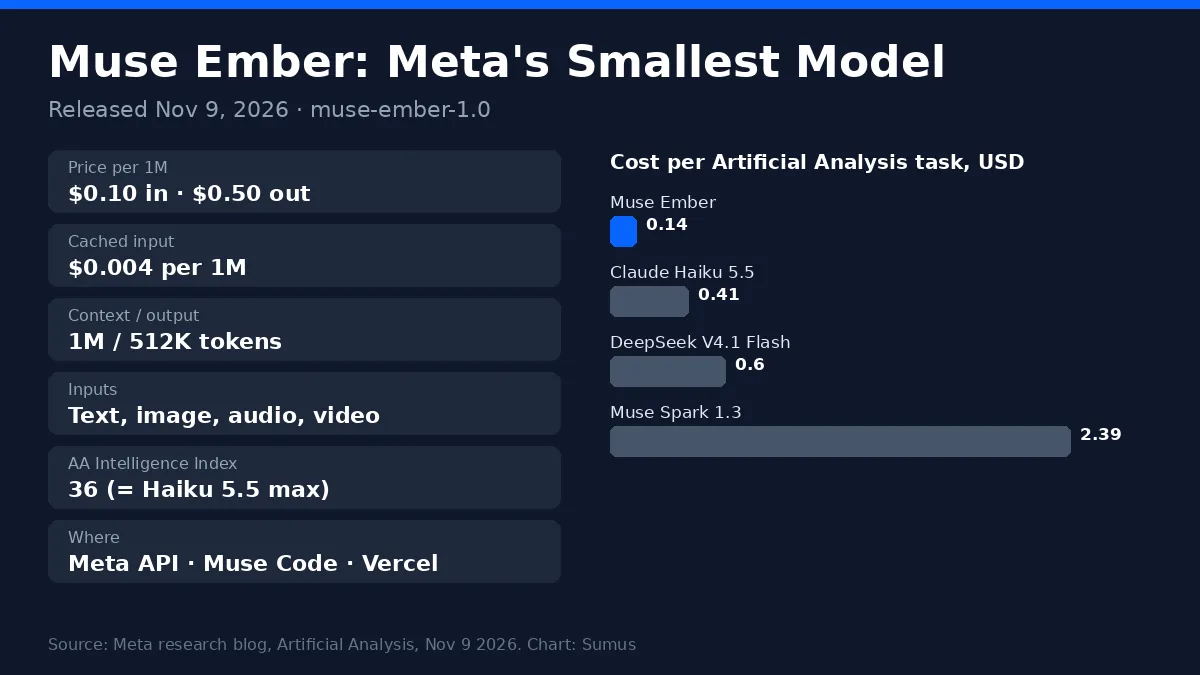
Muse Ember is Meta's new small model for agent work, and its pitch is price. Meta Superintelligence Labs released Muse Ember on November 9, 2026, calling it "our smallest and most efficient model" in the official announcement. It matches Claude Haiku 5.5 on the Artificial Analysis index at about a third of the cost per task.
Below: Muse Ember price and specs, the benchmark table, what the first testers say on X, how it pairs with Muse Wonder, and who should switch.
Muse Ember at a glance
Item | Muse Ember detail |
|---|---|
Maker | Meta Superintelligence Labs |
Release date | November 9, 2026 |
Model ID | muse-ember-1.0 |
Price per 1M tokens | $0.10 input · $0.004 cached · $0.50 output |
Context / max output | 1M tokens / 512K tokens |
Inputs | Text, images, audio and video |
Where to use it | Meta Model API, Muse Code, Vercel AI Gateway |
Trained with | Muse Wonder Full (first model to be) |
It also supports the Responses API, so tools already built for that format can switch with a model name change. One catch raised on X: prompts over 200K tokens are billed at a higher rate, so the long-context price is not the headline price.
What Muse Ember is built for
Meta says agents spend most of their tokens on many small, structured steps, and this model is made for exactly those. Think reading files, running tests, making a targeted fix, pulling records, calling tools in order and updating systems across apps. With 1M tokens of context, it can take a full codebase or document set in one call.
Meta's one-line plan for its model family is "Muse Wonder plans, Muse Ember handles the volume." A big model sets the rules for a job, then the small model applies them across thousands of cases, such as support tickets, contracts or invoices. Muse Spark sits in the middle for coding and agent workflows.
Muse Ember benchmarks vs Claude Haiku 5.5 and GPT-6 Luna
Benchmark (max reasoning) | Muse Ember | Claude Haiku 5.5 | GPT-6 Luna |
|---|---|---|---|
AutomationBench-AA | 37.8 | 13.9 | 20.2 |
Agents' Last Exam | 61.6 | 57.0 | 57.1 |
Terminal-Bench 4.0 | 40.9 | 39.2 | 16.4 |
Coding Agent Index-AA | 46 | 37 | 31 |
FrontierCode 2.0-AA | 27.2 | 34.9 | 25.2 |
OSWorld 2.1 (partial) | 69.5 | 68.9 | 50.5 |
PerceptionBench (tools) | 80.6 | 78.6 | 62.8 |
Artificial Analysis Index | 36 | 36 | 28 |
Numbers are from Meta's launch post, most of them run by Artificial Analysis. Meta's model wins seven of eight rows. The one clear loss is FrontierCode 2.0, where Claude Haiku 5.5 leads on real engineering tasks judged on whether the code can be merged.
Artificial Analysis adds detail. Muse Ember (max) is the cheapest model scoring 36 or more, at $0.14 per task; Claude Haiku 5.5 (max) costs $0.41 for the same score. It is also about 4x cheaper than DeepSeek V4.1 Flash 1017 (score 33, $0.60). The big saving comes from cached input, 60% cheaper than rivals, and from using about a third as many output tokens as Haiku.
Muse Ember weak spots
Knowledge is the main gap. Its AA-Omniscience accuracy is 21.1%, the lowest among models at its level, against 34.7% for Claude Haiku 5.5 and 50.5% for Gemini 3.8 Flash. That is mostly because it declines 64% of the questions it is not sure about, which keeps its hallucination rate at 17.4%, half of Haiku's.
So use it to do work on data you hand it, not to answer trivia from memory. It also trails Haiku on AA-Briefcase (1521 vs 1574 Elo), a test of office-style tasks.
What early Muse Ember users say on X
- Alexandr Wang (Meta): Muse Ember gives "nearly Muse Spark 1.3 (max) intelligence at a 17x cheaper price point". His launch post passed 216,000 views.
- You.com: every coding quest done with a p95 latency of 2.2 seconds, 4x to 13x faster than leading open-weight models, with 36–48% fewer output tokens.
- Cloudflare: up to 30% faster at the tail than the comparable model it tested.
- Pi Dash: ten Muse Code agents on the new model rewrote about 178,000 lines from raw SQL to SeaORM in one day.
- Vercel: the model went live on AI Gateway within hours of launch.
Muse Ember vs Muse Spark 1.3 and Muse Wonder
Model | AA Index | Cost per AA task | Price in / out per 1M |
|---|---|---|---|
Muse Ember (max) | 36 | $0.14 | $0.10 / $0.50 |
Muse Spark 1.3 (max) | 37 | $2.39 | $1.25 / $4.25 |
Muse Wonder (max) | 44 | $6.95 | — |
Ember is one point behind Muse Spark 1.3 for about 1/17th of the cost, and eight points behind Muse Wonder for about 1/50th. For bulk agent steps, that trade is easy. For the hardest planning work, keep a bigger model on top.
Should you switch to Muse Ember?
Switch if your agent bill is mostly small repeated calls: routing, extraction, tagging, test runs, sub-agent coding. Run a day of real traffic on it next to your current small model and compare cost per finished task, not cost per token.
Wait if your work leans on what the model knows by heart, or on merge-ready code from one shot. Haiku still leads FrontierCode, and Ember says "I don't know" more often.
Get a team that tests new models for you
Yes, you can skip the testing grind. A Sumus AI Employee reads launch posts like the Muse Ember one, runs your own prompts across GPT, Claude and Gemini side by side, and hands back a short table your team can check in the same chat. Compare Claude Haiku 5.5 and DeepSeek V4.1 Flash the same way.
What we're watching
- Muse Ember on OpenRouter and other gateways, and its price there.
- Independent coding tests beyond Muse Code.
- Meta's next, "even more efficient" models in training.
FAQ
Is Muse Ember open source?
No. It is an API model on the Meta Model API and Muse Code; Meta has not released weights.
What is the Muse Ember context window?
1 million tokens in, up to 512,000 tokens out. Prompts over 200K tokens cost more.
Is Muse Ember multimodal?
Yes. It reads text, images, audio and video, so agents can work from screenshots, scans, voice memos and recordings.
Who tested Muse Ember before launch?
Meta names Box, Cline, Oracle, Cloudflare and You.com as early partners.
Are the Muse Ember benchmarks independent?
Most rows were run by Artificial Analysis; Agents' Last Exam, OSWorld 2.1 and PerceptionBench are Meta's own tests.
Can a Sumus AI Employee compare Muse Ember with my current model?
Yes. Give it your prompts and it runs a side-by-side test across the models you use, then reports cost and quality in your team chat.
Update log
- — Nov 10: First published. Muse Ember launch, price, benchmarks, Artificial Analysis results and early X feedback.